
Education Loan for MBA in UK
Share this blog


An MBA from a UK business school can open doors to global careers in consulting, finance, technology and management. But it can also require a substantial investment.
Tuition alone can range from approximately INR 45.24 lakh (£35,000) at some universities to more than INR 1.55 crore (£120,000) at a leading institution such as London Business School. Once accommodation, travel, visa charges and everyday expenses are added, the total cost can easily reach INR 64.64 lakh–₹2.33 crore (£50,000–£180,000).
For most students, paying the entire amount from savings is not practical. That is where an education loan to study in the UK becomes important.
The right loan can help you pay tuition and living expenses without exhausting your family’s savings. The wrong loan, however, can leave you managing a high EMI, currency fluctuations and years of avoidable interest.
Can You Get an Education Loan for an MBA in the UK?
Yes. International students can obtain education loans for full-time MBA programmes offered by recognised UK universities and business schools.
Depending on your nationality and financial profile, funding may be available from:
- Banks in your home country
- Non-banking financial companies
- International education lenders
- University-linked financing partners
- Government postgraduate loan schemes, if you satisfy residency rules
- Employers offering MBA sponsorship
Indian students, for example, can apply through public-sector banks, private banks, education-focused NBFCs and international lenders.
Admission to a highly ranked university can improve your chances of receiving a larger loan or qualifying for collateral-free financing. Nevertheless, approval is never based on the university alone. Lenders also examine your academic background, work experience, cosigner income, credit history and expected post-MBA employability.
Types of MBA Student Loans for the UK
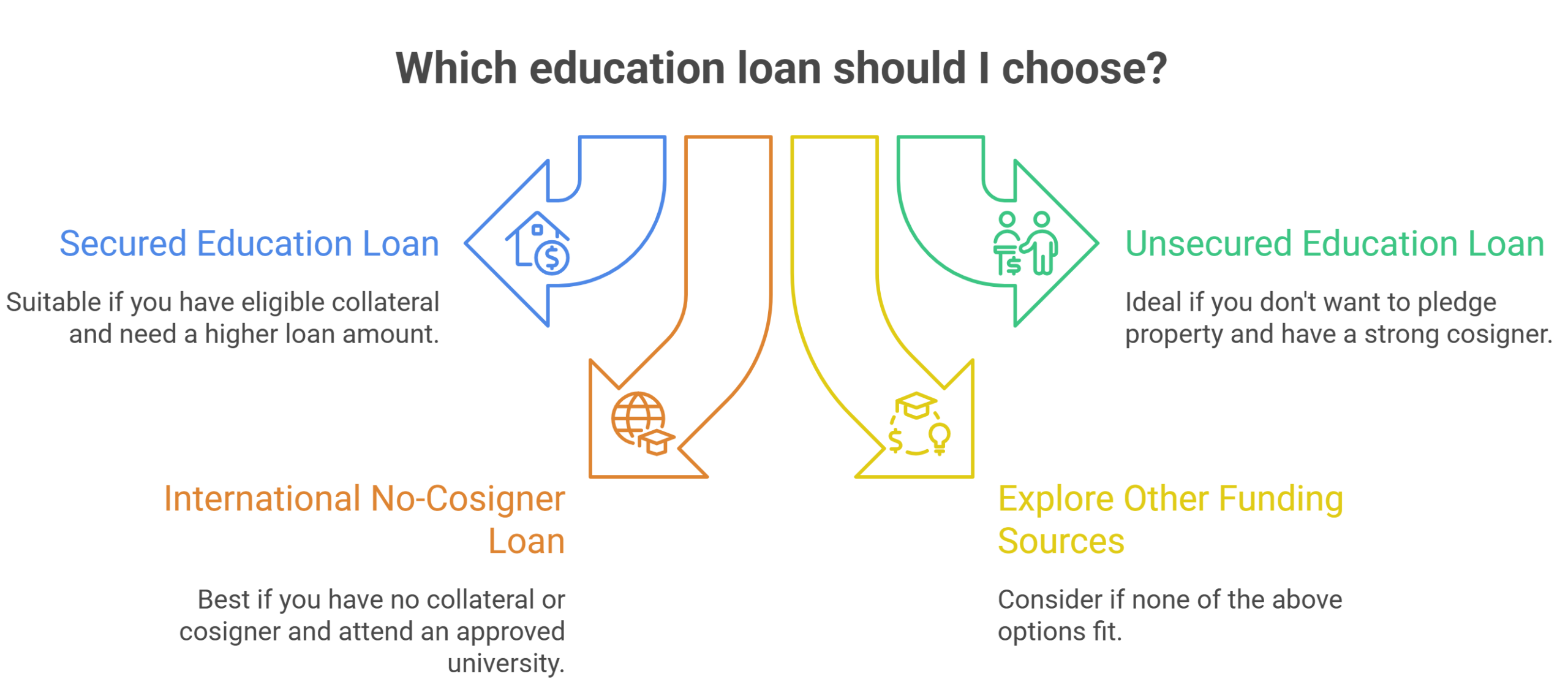
Students generally have four financing routes.
1. Secured Education Loan
A secured loan requires collateral such as residential property, commercial property, a fixed deposit or another asset accepted by the lender.
Secured loans usually offer:
- Lower interest rates
- Higher loan amounts
- Longer repayment periods
- More flexible coverage of living expenses
- Better approval prospects for expensive programmes
However, the collateral must pass legal and valuation checks. The process can therefore take longer, and the asset is at risk if the loan cannot be repaid.
A secured loan is often the most economical choice for students who need substantial funding and have acceptable collateral.
2. Unsecured Education Loan
An unsecured loan does not require property or another pledged asset.
Approval generally depends on:
- University and course
- Student’s academic record
- Work experience
- Expected future income
- Cosigner’s income and credit profile
- Requested loan amount
These loans are easier to process but typically carry higher rates. The lender may also limit the amount sanctioned for lower-ranked universities.
An unsecured loan can be suitable when the student has a strong profile and requires a moderate amount, but it should be compared carefully with a secured offer.
3. International No-Cosigner Loan
International lenders may finance selected MBA programmes to study in the UK without requiring collateral or a family cosigner. Instead, they typically evaluate the applicant’s university, academic record, professional experience and expected earning potential.
These loans can be useful for students who do not have suitable collateral or a qualifying cosigner in their home country. Applications are often completed online, and funding may cover tuition as well as approved living expenses.
The main advantage is easier access to funding. However, students should carefully review the total repayment amount, applicable fees, repayment currency, moratorium terms and prepayment conditions before accepting an offer.
4. UK Postgraduate Government Loan
An MBA may qualify as an eligible master’s programme, but most newly arriving international students cannot obtain the UK government’s Postgraduate Master’s Loan.
Eligibility is primarily based on nationality, immigration status and prior residence. Applicants who are UK or Irish citizens, have settled status or fall within another eligible residence category should check the detailed rules.
See the UK Postgraduate Master’s Loan eligibility requirements.
Need Help Finding the Right Education Loan for Your UK MBA?
Comparing education loans for an MBA in the UK can be time-consuming. Eligibility requirements, collateral conditions, repayment terms and eligible expenses can vary considerably between lenders.
Nomad Credit helps you explore suitable loan options from Indian banks, NBFCs and international lenders in one place. Based on your university, funding requirement and financial profile, the team can help you:
- Understand which loan options you may qualify for
- Compare relevant offers and repayment terms
- Evaluate secured and collateral-free loan options
- Identify the documents required for your application
- Receive guidance throughout the loan process
Instead of approaching multiple lenders separately, you can make a more informed decision with expert support at every stage.
Apply for an Abroad Education Loan!
How Much Does an MBA in the UK Cost?
The cost depends on the business school, location and programme duration.
Here are a few published examples:
| Business school | Published tuition fee |
| London Business School, 2026 MBA intake | INR 1.60cr (£123,950) |
| Cambridge Judge, September 2027 entry | INR 1.11cr (£86,250) |
| Warwick Business School, 2026 full-time MBA | NR 76.92 lakh £59,500 |
| Other UK universities | Commonly 45.24–₹77.56 lakh (£35,000–£60,000) |
Tuition figures can change by intake. Always check the university’s current fee page before finalising your budget.
For reference, see the published fee information from London Business School and Cambridge Judge Business School.
Additional Expenses to Include
Tuition is only one part of the total cost. Your financial plan should also account for:
- University deposit
- Accommodation and utilities
- Food and personal expenses
- Student visa fee
- Immigration Health Surcharge
- Flights and local travel
- Books, laptop and study materials
- Loan processing and insurance charges
- Career fairs and recruitment-related travel
- Emergency expenses
- Foreign-exchange fluctuations
For the UK Student visa financial requirement, applicants currently need to show up to £13,761 for study in London or £10,539 outside London. These are minimum visa figures, not guaranteed estimates of actual living costs. London accommodation, in particular, can push real spending above the official minimum.
Check the latest amount on the UK government’s Student visa financial requirement page.
What Does an Education Loan for a MBA in UK Actually Cover?
An education loan for an MBA in the UK typically covers more than just tuition fees. Depending on the lender and loan terms, it can finance most of the essential expenses associated with studying and cost of living in the UK, including:
- 100% Tuition Fees – Covers the tuition charged by your UK university.
- Living and Accommodation Expenses – Helps pay for rent, food, utilities, and other daily living costs.
- UK Student Visa Fees – Covers mandatory visa application and related immigration charges.
- Travel Expenses – Includes airfare to the UK and, in some cases, local travel expenses.
- Books, Laptop, and Study Materials – Helps cover the cost of textbooks, software, and other academic essentials, subject to lender policies.
- Health Insurance and Medical Costs – May include eligible healthcare expenses, such as the Immigration Health Surcharge (IHS), depending on the lender.
- Other Approved Educational Expenses – Some lenders also finance examination fees, project expenses, and other course-related costs.
When to Start the Education Loan Process for an MBA in the UK
Start your education loan process for an MBA in the UK as soon as you receive your university offer letter. Ideally, begin comparing lenders and gathering documents 3–6 months before your course starts.
This gives you enough time for loan approval, visa applications, fee payments, and travel planning without any last-minute stress. A well-planned loan process also helps you secure better terms and comfortably meet your university deadlines.
Eligibility Criteria for Overseas Education Loans for an MBA in the UK
To apply for an overseas education loan for an MBA in the UK, international students generally need to meet the following eligibility requirements:
- Confirmed admission to a recognized UK university or business school.
- Good academic record in previous qualifications.
- Graduate degree from a recognized university (as required for MBA admission).
- Co-applicant with a stable income for most Indian education loans.
- Collateral may be required for higher loan amounts, while eligible students can also explore an education loan without collateral.
- Complete loan documentation, including academic, admission, KYC, and financial documents.
Documents Required for an MBA Education Loan in the UK
Whether you are applying for a secured loan or an abroad education loan without collateral, having the right documents will help you get quicker approval. While document requirements vary by lender, most banks, NBFCs, and international lenders ask for the following documents.
- Identity & KYC Documents: PAN Card, Aadhaar Card, Passport, recent recent passport-size photos, and address proof of the applicant and co-applicant.
- Academic Documents: Class 10 & 12 mark sheets, bachelor’s degree certificate, academic transcripts, GMAT/GRE scorecard (if applicable), and IELTS/TOEFL/PTE/Duolingo Scorecards.
- Admission Documents: University offer letter, CAS (Confirmation of Acceptance for Studies), tuition fee structure, and course details.
- Income Documents (Co-applicant): Salary slip (last 3 months), Form 16/Income tax returns, employment certificate, and bank statements (last 6-12 months).
- Collateral Documents (If Required): Ownership proof of property, Valuation report, and other legal documentation for secured education loans.
- Other Documents: Loan application form filled and estimated cost of education or expense statement.
Post-MBA Salary Benchmarks in UK
Your repayment for UK education loan for MBA structure relies entirely on your immediate post-graduation job market placement. In the UK, compensation is heavily dictated by location (London vs. regional cities), your specific industry, and your pre-MBA experience.
Average National Salary Ranges
- Fresh/Entry-Level Corporate Management: £45,000 – £60,000 per year.
- Mid-Senior Management (3–5 Years Post-MBA): £70,000 – £90,000 per year.
- Top-Tier / Elite Institutional Hires: £100,000 – £120,000+ per year.
Sector-Specific Compensation Profiles
The highest starting compensation structures for international MBA graduates are concentrated across three high-intent corporate verticals:
| Industry | Average Starting Base Salary | Primary Recruiting Targets |
| Strategy Consulting | £65,000 – £95,000 | McKinsey, Boston Consulting Group (BCG), Bain, Deloitte |
| Investment Banking & Finance | £80,000 – £120,000 | Barclays, HSBC, Goldman Sachs, Bank of America |
| Technology Leadership / Product | £62,000 – £85,000 | Amazon, Google, FinTech Startups |
Finding the Right Funding Mix for Your MBA in the UK
The cost of obtaining an MBA in the UK is not necessarily dependent on just one way of financing. There are quite many foreign students who cut down on the total cost of their studies by using both an education loan for MBA and scholarships in the UK for international students. You can build a smarter funding plan by:
- Applying for UK scholarships to reduce your tuition costs before taking a loan.
- Choosing an education loan only for the remaining expenses, including tuition, living costs, travel, and study materials.
- Claiming tax benefits on the interest paid under Section 80E (for eligible education loans from approved lenders).
- Planning your loan disbursement to match your university’s fee payment schedule and budgeting separately for visa fees, accommodation deposits, insurance, and other initial expenses.
- Comparing lenders to find competitive interest rates and education loan without collateral options, if eligible.
A combination of scholarships and the right education loan can help you finance your MBA with less financial stress and a lower repayment burden after completing your degree.
Common Mistakes to Avoid When Taking an Education Loan in UK
- Choosing the first lender you find instead of comparing UK education loan options from banks, NBFCs, and global lenders.
- Borrowing only for tuition and overlooking accommodation, living expenses, visa fees, insurance, and travel costs.
- Ignoring loan terms such as interest rates, processing fees, repayment options, and prepayment charges.
- Delaying your loan application, which can affect university fee deadlines and your UK student visa process.
- Submitting incomplete documents, leading to unnecessary delays in loan approval.
- Not exploring scholarships, which can reduce the amount you need to borrow for your MBA in the UK.
- Overlooking education loan without collateral options, even if you’re eligible for t
Getting the right education loan can save you a lot of money over a decade. Use a checklist to compare your options, a comprehensive guide to education loans for studying abroad, or get expert advice from Nomad Credit to avoid making these errors.

Frequently Asked Questions
What is the maximum loan amount for overseas education from Indian banks?
Secured loans go up to ₹1.5–₹3 crore (€180,000–€360,000) (SBI Global Ed-Vantage). Unsecured loans cap at ₹7.5–₹50 lakh (€9,000–€60,000) depending on the lender and institute ranking.
Can international students get UK government student loans?
UK government loans are generally not available to Indian students. EU students may access capped tuition loans of £9,250 (€10,500) per year. Indian students rely on Indian bank loans or private international student loan UK providers.
How is Nomad Credit different from going to a bank directly?
Nomad Credit offers fee-free counselling and multi-lender comparison across 20+ lenders. You see eligible loan options matched to your profile – saving time, money, and effort compared to approaching each bank individually.
When do I start repaying the loan?
You start repaying after the moratorium period ends – typically course duration plus 6–12 months. You don’t need to start paying principal during your studies.
Can I combine scholarships with an education loan?
Yes. Certain scholarships reduce your loan requirement, and banks adjust the sanctioned amount accordingly. International students can apply for Commonwealth Scholarships alongside an education loan.

Share this blog
Speak to an Expert
It’s completely free.
Related Blogs


Bank, Finances & Tips
When is the Best Time to Refinance Student Loans: Key Factors to Know
If you’re asking when to refinance student loans, here’s the direct answer: the best time to refinance student…
7 min
Education Loan
How to Get an Education Loan for MS in Canada?
An MS education loan in Canada requires more than planning for the tuition charges. Accommodation costs, expenses of…
13 mins
Speak to an Expert
Trusted by students in 9+ countries to secure funds for their dreams

Popular Blogs Section





Financing dreams of global
nomads




Student Support
support@nomadcredit.com
Partner Support
partnerships@nomadcredit.com
Important Links
Offices

Chicago, US
Millennium Centre, 33 W Ontario St Suite 18D, Chicago, IL 60654,
United States

Mumbai, India
Sundervilla, A wing 314B, Hasmukh Nagar, Santacruz (West), Mumbai,
MH 400054
Registered Office
We
work, Goregaon, Building 4, North Wing, NESCO IT Park, Western
Express Highway, Goregaon East, Mumbai, MH 400063
GST Regn
No:
27AAGCN6529G1Z9
Partner
offices in 30+
cities globally
 Copyright
© Unifi Lending LLC. All Rights Reserved.
Copyright
© Unifi Lending LLC. All Rights Reserved.
Speak to an expert
