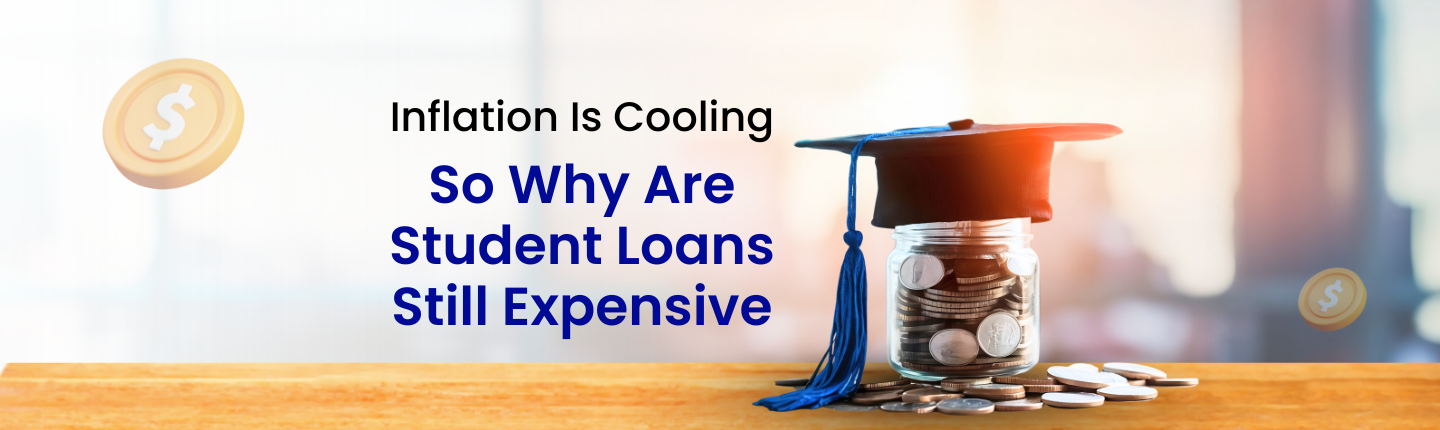
2026 Student Loan Interest Rates Explained: Why Rates Aren’t Dropping Despite Inflation Cooling
Share this blog


In this article
- Inflation vs Interest Rates: The Real Difference
- How Student Loan Interest Rates Are Decided
- Federal Student Loans vs Private Student Loans
- What We Know About 2026 Student Loan Interest Rates
- Why Interest Rates Are Still High
- Impact on Study Abroad and International Students
- What Borrowers Should Expect in 2026
- How to Manage High Student Loan Interest Rates
- Key Points to Remember
- Frequently Asked Questions
For students planning higher education in the U.S. or overseas, loan affordability has become a major concern. Many expected borrowing costs to ease once inflation slowed. However, as 2026 approaches, loan interest rates remain stubbornly high.
This is especially worrying for study abroad aspirants who rely on student loan USA options to fund tuition, living expenses, and travel. Despite positive inflation news, monthly EMIs and total repayment amounts still look heavier than expected.
Understanding 2026 student loan interest rates requires going beyond headlines and looking at how education loans are priced in reality.
Inflation vs Interest Rates: The Real Difference
Inflation reflects rising prices for everyday goods. Interest rates, on the other hand, reflect the cost of borrowing money over time.
While U.S. inflation has cooled compared to previous years, the Federal Reserve continues to maintain higher benchmark rates. The goal is not just to control current inflation but to prevent it from rising again.
As policymakers often emphasize, interest rates tend to stay high longer than inflation itself.
This delay directly affects anyone asking what is the interest rate on student loans in the US for upcoming academic years.
How Student Loan Interest Rates Are Decided?
Student loan rates are not set randomly, nor are they adjusted monthly like credit cards.
Federal Student Loans
The interest rates charged on federal student loans are determined each year and are tied to the yield on the 10-year U.S. Treasury security with a legally specified mark. Announced rates are announced on the basis of annual Treasury auctions, which take place in May.
Private Student Loans
All larger student loan US banks, as well as with other major banks, are privately lenders and employ a risk based pricing model. Interest rates depend on:
- Market interest rates
- History of credit and cosigner power.
- Loan amount and tenure Citizen status of borrowers.
In the case of international students, this tends to increase the rates as a result of perceived risk.
Federal Student Loans vs Private Student Loans
| Loan Type | Rate Structure | Key Impact in 2026 |
| Federal Student Loans | Treasury yield + fixed margin | Stable but elevated |
| Private Student Loans | Market and risk-based | Higher for non-US citizens |
This distinction matters greatly for students planning to study abroad, as many are not eligible for federal aid.
What We Know About 2026 Student Loan Interest Rates
Although official federal rates for 2026 will only be confirmed closer to the academic cycle, strong indicators already exist.
- U.S. Treasury yields remain above pre-pandemic levels
- Government borrowing continues at a large scale
- Financial markets expect rates to stay “higher for longer”
As a result, 2026 student loan interest rates are likely to remain similar to recent years rather than drop sharply.
This outlook affects both undergraduate and graduate students, particularly those seeking student loan USA options from private lenders.
Why Interest Rates Are Still High For International Students?
- First Treasury yields are sensitive to long-term economic projections and not to any changes in short-term inflation.
- Second, the increasing government debt continues to make borrowing costs high.
- Third, students loans are still being priced with caution by the private lenders because of the risk of default. In the case of international borrowers, there are other conditions like visa status, absence of U.S. credit history and currency fluctuations which make the rates even higher.
Impact on Study Abroad and International Students
The interest rates have the tendency of affecting students hoping to study at the U.S., UK, Canada or Europe even when the loan is not taken in the U.S. Much of the foreign lending compares their prices to that of the U.S. financial markets. Consequently, increasing U.S. rates will result in:
- Greater monthly payments.
- Higher total loan costs
- Reduced borrowing capacity
This renders it very important to plan finances early in life among the study abroad aspirants.
What Borrowers Should Expect in 2026?
Students who will take overseas education loans in 2026 must not be hoping that waiting would lead to lower borrowing costs. In lieu, they ought to be ready when there is a high rate environment by designing the loan structure and not timing the market. The key points to note are:
- Fixed vs variable interest rates
- Grace periods and repayment flexibility
- Partial self-funding options
- Comparing lenders beyond just interest rates
How to Manage High Student Loan Interest Rates?
Students are able to decrease the long-term costs by making informed decisions even in a high-rate environment.
Taking out the required amount of money, ensuring the cosigner’s profile is stronger, selecting a shorter term where feasible, and understanding the repayment terms can help considerably reduce the amount of interest paid. Handling loan conditions correctly may matter more than minute alterations in interests as pointed out by financial advisors.
Key Points to Remember
- The rate on student loans does not decrease directly with inflation.
- Treasury yields are used for federal loans.
- Market risk is indicated by the rates of private student loans offered by US banks.
- There is are increase in borrowing costs among international students.
- Waiting is less effective than early planning.

Frequently Asked Questions
What is the interest rate on student loans in the US for 2026?
Exact rates will be announced later, but current trends suggest they will remain relatively high compared to pre-2020 levels.
Will student loan interest rates go down if inflation drops further?
Not immediately. Interest rates depend on long-term economic expectations and government borrowing costs.
Are private student loans costlier than federal loans?
Yes, especially for international students who are considered higher risk by lenders.
Why do international students pay higher interest rates?
Limited credit history, visa uncertainty, and currency risks lead lenders to charge higher rates.
Is it better to apply early for a student loan?
Yes. Early planning allows students to compare lenders, secure better terms, and avoid last-minute financial pressure.

Share this blog
Speak to an Expert
It’s completely free.
Related Blogs

Education Loan
What Are The Pros And Cons of Refinancing Student Loans?
Key Takeaways: Refinancing student loans may help you secure a lower interest rate, reduce monthly payments, or save on…
7 min
Education Loan
MBA Student Loan Refinance: A Complete Guide for Graduates
Key Takeaways: MBA student loan refinance will enable graduates to get reduced interest rates, change payment amounts, or…
5 min
Speak to an Expert
Trusted by students in 9+ countries to secure funds for their dreams

Popular Blogs Section


Financing dreams of global
nomads




Student Support
support@nomadcredit.com
Partner Support
partnerships@nomadcredit.com
Important Links
Offices

Chicago, US
Millennium Centre, 33 W Ontario St Suite 18D, Chicago, IL 60654,
United States

Mumbai, India
Sundervilla, A wing 314B, Hasmukh Nagar, Santacruz (West), Mumbai,
MH 400054
Registered Office
We
work, Goregaon, Building 4, North Wing, NESCO IT Park, Western
Express Highway, Goregaon East, Mumbai, MH 400063
GST Regn
No:
27AAGCN6529G1Z9
Partner
offices in 30+
cities globally
 Copyright
© Unifi Lending LLC. All Rights Reserved.
Copyright
© Unifi Lending LLC. All Rights Reserved.
Speak to an expert
