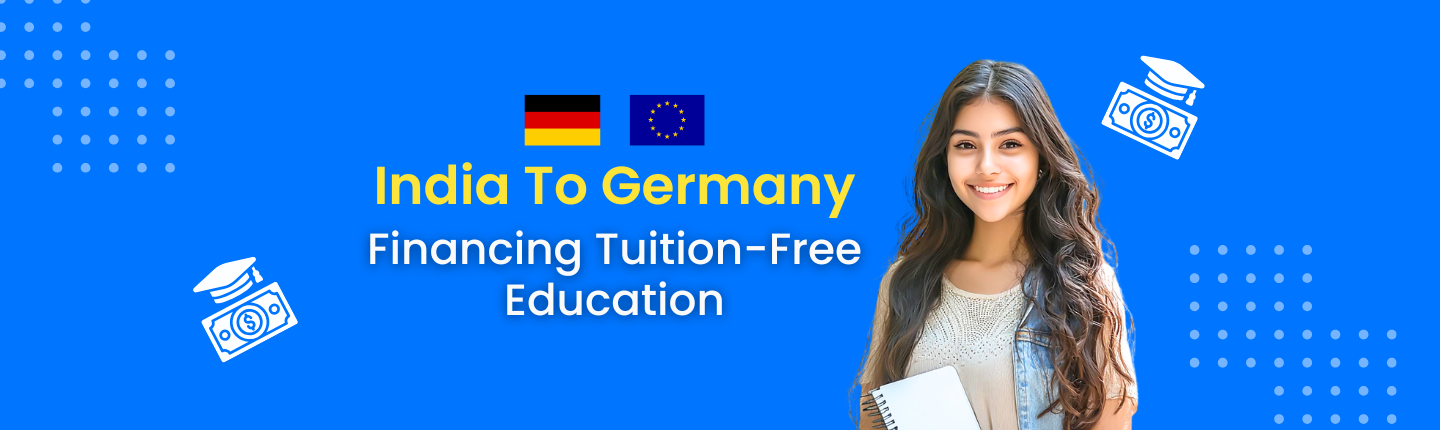
Education Loan for Germany & Europe: How Indian Students Fund Tuition-Free Universities
Share this blog


In this article
- Why Do Indian Students Still Need a Loan for Tuition-Free Universities in Germany?
- How Much Does It Actually Cost to Live in Germany as a Student?
- Which Bank or NBFC Should I Choose for an Education Loan for Germany?
- Can I Get a Germany Education Loan Without Collateral or Property?
- How Should I Plan My Loan for MS, MBA, or Masters in Europe?
- SBI vs Avanse vs Credila – Which Is Best for a Germany Education Loan?
- Studying in Europe but Not Germany – Which Lender Should I Pick?
- So, Is Taking an Education Loan for Germany Worth It?
- Frequently Asked Questions
You just got your admission letter from TU Munich or Heidelberg University. You’re thrilled, no tuition fees, world-class education, and a degree that opens doors globally. But then reality hits: “Wait, how do I actually afford to live in Germany for two years?”
This is the moment most Indian students realize that “tuition-free” doesn’t mean “cost-free.” Rent, groceries, health insurance, and a mandatory blocked account can easily demand INR 20-30 lakhs before you even land at Frankfurt Airport.
If you’re wondering how to arrange funds to study in Germany without selling your family’s assets, this guide is for you.
Plan Your Germany Admission Today
Why Do Indian Students Still Need a Loan for Tuition-Free Universities in Germany?
Germany’s public universities charge a nominal semester fee of €100-€400, covering admin charges and sometimes a public transport pass. But the cost of living in Germany is not cheap.
Cities like Munich, Frankfurt, and Stuttgart are among the most expensive in Europe. Even in affordable cities like Berlin or Leipzig, a student spends €800-€1,200 per month on rent, food, transport, health insurance, and personal expenses.
For a 2-year Master’s program, here’s what total costs look like:
- Living expenses: €10,000-€14,000 per year
- Health insurance: €120-€500/month (mandatory)
- Blocked account requirement: €11,904/year (one-time deposit)
- Flight + visa + initial setup: INR 1.5-2 lakhs
- Semester fees (2 years): €600-€1,400 total
Most Indian students need INR 20-35 lakhs to fund a 2-year Master’s in Germany, even without paying a rupee in tuition. That’s why a student loan for Germany universities is not just common; it’s practically essential.
How Much Does It Actually Cost to Live in Germany as a Student?
Before you step into a German university, the consulate requires proof you can financially support yourself, in the form of a blocked account (Sperrkonto).
What Is a Blocked Account?
A blocked account is a special German bank account where you deposit a fixed amount upfront. The government mandates a minimum of €11,904/year (as of 2026), roughly INR 10-11 lakhs. You can only withdraw a fixed €992/month after arriving in Germany.
Here’s a monthly living cost breakdown (approximate):
| Expense Category | Monthly Cost (€) | Annual Cost (INR approx.) |
| Rent (shared flat) | €350-€550 | INR 3.6-5.7 lakhs |
| Food & groceries | €150-€200 | INR 1.5-2 lakhs |
| Health insurance | €110-€160 | INR 1.1-1.7 lakhs |
| Transport | €30-€80 | INR 30k-80k |
| Personal/misc | €100-€150 | INR 1-1.5 lakhs |
| Total | €740-€1,140 | INR 7.8-12 lakhs/year |
For a 2-year program, total living costs range between INR 15-25 lakhs, excluding the blocked account deposit.
Which Bank or NBFC Should I Choose for an Education Loan for Germany?
Indian students have two categories of lenders for an education loan for Germany: public sector banks and NBFCs.
Public Sector Banks
SBI’s Global Ed-Vantage funds up to INR 1.5 crore and is trusted by German consulates. Bank of Baroda and Union Bank also offer overseas education loans for Germany at competitive rates.
NBFCs
Avanse, Credila, and ICICI are faster and offer no collateral loan for Germany, ideal for families without property.
Key differences:
| Factor | Public Banks (e.g., SBI) | NBFCs (e.g., Avanse, Credila) |
| Interest Rate | 9-11% (lower) | 11-14% (higher) |
| Processing Time | 3-6 weeks | 1-2 weeks |
| Collateral Requirement | Required above INR 7.5L | Optional / no-collateral options |
| Loan Amount | Up to INR 1.5 crore | Up to INR 75L – INR 1 crore |
| Repayment Flexibility | Moderate | Higher |
| Co-applicant Required | Yes | Yes |
Can I Get a Germany Education Loan Without Collateral or Property?
Not every family owns property to mortgage. This is where no-collateral education loans, also called unsecured loans, come in.
Several lenders offer a Germany education loan without collateral:
- Avanse: Collateral-free loans up to INR 40-50 lakhs; co-applicant required.
- Credila (HDFC): Flexible unsecured loans; can include blocked account amount.
- MPOWER Financing: No co-signer or collateral; higher interest at 13-15%.
- Prodigy Finance: Euro-disbursed loans; no collateral, but covers select universities only.
How Should I Plan My Loan for MS, MBA, or Masters in Europe?
Different programs in Germany and Europe have different loan planning needs. Here’s how to think about it:
- MS in Germany Loan: No tuition at public universities. Budget INR 20-30 lakhs for living costs + blocked account. Structure your education loan for Masters in Germany with a moratorium covering course duration + 6 months post-graduation.
- MBA in Germany Loan: Private B-schools like Mannheim or Frankfurt School charge €20,000-€45,000 tuition. Total MBA in Germany loan requirement can reach INR 40-60 lakhs.
- Education Loan for Masters in Europe: Costs vary, Netherlands/Ireland charge €10,000-€20,000/year; Sweden/Norway/Finland is free for EU but Indians pay tuition; France’s public universities are subsidized.
For Europe cosigner loans, Avanse, Credila, and Prodigy Finance cover most top European institutions. Apply early, processing takes 2-4 weeks.
SBI vs Avanse vs Credila – Which Is Best for a Germany Education Loan?
Here’s a side-by-side comparison of the three most popular lenders Indian students use for an education loan for Germany:
| Lender | Best For | Key Advantage |
| SBI Global Ed-Vantage | Lowest interest rate | Widely recognized by German consulates |
| Avanse | Fast disbursal, no collateral | Covers blocked account within loan |
| Credila (HDFC) | Flexible repayment | Approves newer/less-ranked universities |
All three require: Admission letter, co-applicant’s ITR + salary slips, and university cost breakdown.
Compare Germany Education Loans Now
Studying in Europe but Not Germany – Which Lender Should I Pick?
Your loan strategy should depend not just on where you’re studying, but what you’re studying and what your family’s financial profile looks like.
- Choose SBI if: Best if your family has collateral and you’re targeting TU Munich, RWTH Aachen, or KIT.
- Choose Avanse or Credila if: Best if you need faster approval, have no collateral, or your university isn’t on SBI’s list.
- Choose Prodigy Finance if: Best for top-ranked European programs (TU Delft, Bocconi, ESADE) with no co-signer.
- Choose MPOWER if: Best if you have no co-signer, no collateral, and Prodigy doesn’t cover your institution.
If you do have a co-applicant, a Germany cosigner loan from SBI or Avanse will always offer better rates than a no-cosigner option.
So, Is Taking an Education Loan for Germany Worth It?
Germany’s tuition-free universities are a genuine gift, but nobody told you about the blocked account, the health insurance, or the INR 20-35 lakhs you’d still need before your first German winter. The loan part isn’t scary once you know your options.
Whether you’re taking an SBI education loan for Germany, a no-collateral loan from Avanse, or a co-signer-free option from Prodigy Finance, there’s a product for almost every financial profile.
That’s where Nomad Credit helps. As a trusted study abroad consultant, Nomad Credit matches you with the right education loan for Europe or Germany based on your profile, collateral situation, and university, without charging you a rupee.
Thousands of Indian students have already funded their German dream with Nomad Credit’s guidance. Start your loan journey today.

Frequently Asked Questions
How much loan do I need for MS in Germany, and does it cover the blocked account?
For an MS in Germany, most students need INR 20-30 lakhs covering living costs, health insurance, and the Germany blocked account amount of €11,904/year. Yes, lenders like Avanse and Credila can include the loan for blocked account Germany within your total loan amount. SBI may require it to be funded separately.
What is the interest rate for Germany education loans, and how long does approval take?
The education loan for Germany interest rate ranges from 9-11% at public banks like SBI and 11–14% at NBFCs. Approval takes 3-6 weeks at SBI and 10-15 working days at NBFCs.
Can I take a part-time job in Germany to help repay the loan faster?
International students in Germany are allowed to work up to 140 full days or 280 half days per year. Many students use part-time income (€450-€800/month) to cover living costs while studying, which reduces the total amount needed post-graduation for repayment.
What documents are required for a Germany education loan?
Admission letter, co-applicant’s ITR + salary slips, university cost breakdown, and property documents (if collateral-based). These documents also serve as Germany student visa financial proof during your consulate appointment.
What is the total cost of studying in Germany for Indian students?
The cost of studying in Germany for Indian students for a 2-year Master’s ranges between INR 20-35 lakhs, including living expenses, blocked account, health insurance, and travel, even with zero tuition fees.
Can an education loan cover the Germany blocked account amount?
Many lenders can include the blocked account amount as part of the total sanctioned loan, but disbursement terms differ. Students should confirm whether funds are released directly for blocked account use or through another structure.
Do German consulates accept education loan sanction letters as proof of funds?
A sanction letter can support your visa file, but students usually still need to meet blocked account or official proof-of-funds requirements depending on the visa process and disbursement format.
Is a collateral-free education loan enough for Germany public universities?
In many cases, yes, because tuition is low and the main requirement is living expenses. However, the approved amount depends on your co-applicant profile, lender, and total cost estimate.

Share this blog
Speak to an Expert
It’s completely free.
Related Blogs

Education Loan
How Much Does It Cost to Refinance Student Loans? Full Guide
Key Takeaways: Student loan refinancing may have little or no upfront cost, depending on the lender. Your interest…
5 min
Education Loan
Education Loan for MBA in UK
An MBA from a UK business school can open doors to global careers in consulting, finance, technology and…
10 min
Speak to an Expert
Trusted by students in 9+ countries to secure funds for their dreams

Popular Blogs Section




Financing dreams of global
nomads




Student Support
support@nomadcredit.com
Partner Support
partnerships@nomadcredit.com
Important Links
Offices

Chicago, US
Millennium Centre, 33 W Ontario St Suite 18D, Chicago, IL 60654,
United States

Mumbai, India
Sundervilla, A wing 314B, Hasmukh Nagar, Santacruz (West), Mumbai,
MH 400054
Registered Office
We
work, Goregaon, Building 4, North Wing, NESCO IT Park, Western
Express Highway, Goregaon East, Mumbai, MH 400063
GST Regn
No:
27AAGCN6529G1Z9
Partner
offices in 30+
cities globally
 Copyright
© Unifi Lending LLC. All Rights Reserved.
Copyright
© Unifi Lending LLC. All Rights Reserved.
Speak to an expert
