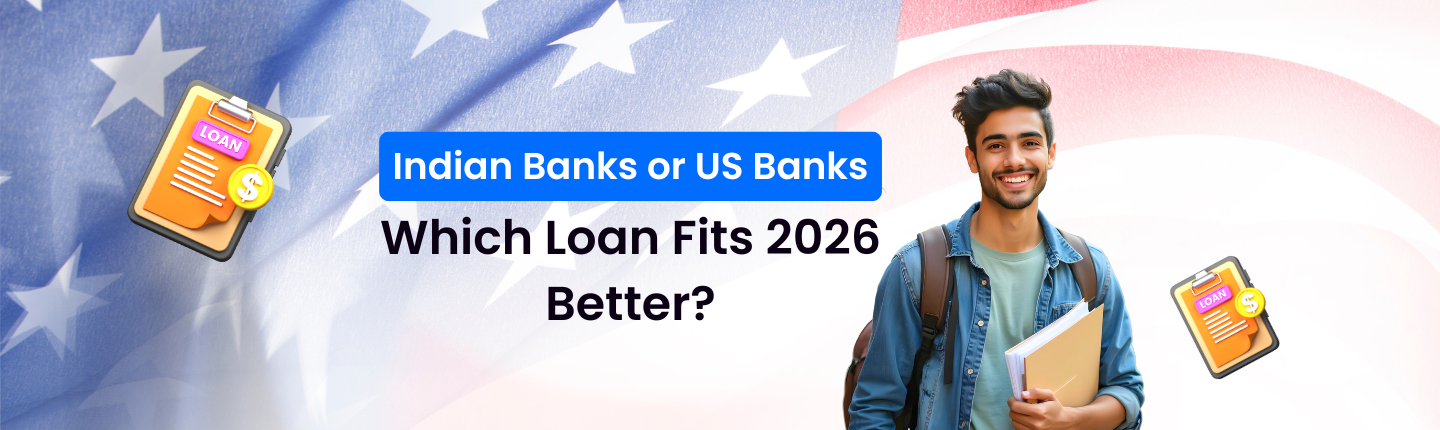
Indian Bank vs US Bank Student Loans: Which Actually Works Better for Studying Abroad in 2026?
Share this blog


In this article
- Which Loan Type Should I Even Choose – Indian or US?
- Which Loan Actually Gives Me a Better Deal for Studying Abroad?
- What Are the Real Pros and Cons of Each Loan Option?
- How to Get an Education Loan in USA for International Students?
- Still Confused About Which Loan to Pick for Studying Abroad?
- Frequently Asked Questions
Dreaming of studying in the USA, Canada, UK, or Europe? You’re not alone, about 1 in 3 Indian students now take loans to fund their international education dreams. But as costs rise and visa hurdles tighten, picking the right loan option has never been more crucial.
Should you go with an Indian bank abroad education loan, or is a student loan from a US bank a smarter path for study in USA and beyond?
Let’s break it down with up‑to‑date insights, so you can decide with confidence for 2026 and beyond.
Simplify Admissions With Nomad Credit!
Which Loan Type Should I Even Choose – Indian or US?
When you’re standing at the crossroads of funding your study abroad journey, it’s easy to feel overwhelmed. Do you stick with an Indian bank you’re familiar with, or explore U.S.-based lenders that deal in dollars?
Understanding how each loan source works, and what it means for your future, is the first step to making the right choice.
Indian Bank Abroad Education Loan
These are loans taken from banks in India, specifically designed to help students finance international education.
- Major providers include SBI, HDFC, Axis, PNB, Indian Bank, and other government/private banks offering loans up to INR 3 Cr depending on collateral and eligibility.
- Often covers tuition, living costs, travel, and exam fees, all in one package.
- May come with collateral requirements (especially for high amounts) or co‑applicant requirements.
- Interest rates vary, often 7-12%+ depending on bank, loan type & collateral.
US Bank (or US Lender) Student Loans
These are loans or credit options offered either by US banks or international lenders that operate in the US.
- US traditional banks (e.g., Discover, Wells Fargo) typically need a US citizen/PR co-signer and an excellent credit record.
- Other lenders such as MPOWER Financing and Prodigy Finance provide loans to international students with no US cosigners or collateral requirements.
- These loans are typically in USD, reducing foreign exchange risk but may have higher interest rates and different repayment structures.
Which Loan Actually Gives Me a Better Deal for Studying Abroad?
Choosing between an Indian bank and a US-based lender isn’t just about where the money comes from, it’s about how that choice impacts your finances, visa, and future opportunities.
Here’s a side-by-side look at the key differences so you can see which loan aligns better with your study plans and personal situation.
| Feature / Criteria | Indian Bank Abroad Education Loan | US Bank / US Lender Student Loan |
| Currency | INR (converted to foreign currency) | USD |
| Collateral Needed? | Often yes for higher amounts | Often yes for traditional banks; no for specialized lenders |
| Cosigner Needed? | Usually not | Typically yes for US banks; no for lenders like MPOWER or Prodigy |
| Covers Living Costs? | Yes (tuitions + costs) | Yes (depends on lender) |
| Eligibility | Indian citizen + admission offer | Varies; cosigner or no cosigner options |
| Interest Rates | 7-12%+* | Variable (often higher for no cosigner) |
| Repayment Term | 10-15 yrs common | 10-15 yrs common |
| Builds US Credit? | No | Yes, helps future US financial footprint |
*Typical Indian bank ranges; exact rate depends on profile & bank.
What Are the Real Pros and Cons of Each Loan Option?
It’s not just about who gives you the money, it’s about how that decision affects your life before, during, and after studying abroad.
From interest rates to repayment flexibility and long-term impact, every loan type comes with its own trade-offs.
Here’s a quick snapshot to help you weigh your options clearly.
| Benefits | Drawbacks |
| Indian Bank Loans |
|
| US Bank / US Lender Loans |
|
How to Get an Education Loan in USA for International Students?
If you’re planning how to get education loan in USA for international students, here’s what most options look like:
- Indian Bank Route:
- Get your offer letter & all documents ready.
- Apply with co‑applicant in India.
- Submit collateral (if required).
- Bank processes loan & disburses funds.
- US Bank / Lender Route:
- Select U.S. lender (traditional bank or otherwise).
- Cosigner (US citizen/PR) might be demanded according to lender.
- Provide admission proof, financials, & identification.
- Loan processed; funds sent directly to the university or bank.
- Specialist International Lenders:
- No cosigner or collateral models exist (e.g., MPOWER, Prodigy)
- Usually based on academic profile & future earning potential
Compare Student Loans With Nomad
Still Confused About Which Loan to Pick for Studying Abroad?
The increase in tuition charges and living expenses can be daunting in the decision between an Indian bank loan and a US student loan.
The best choice depends on your admission offer, financial profile, visa timeline, and long-term goals. It’s not a one-size-fits-all decision, and that’s exactly where the right support makes all the difference.
Nomad Credit, a leading study abroad consultant, helps you compare and apply for the most suitable education loans, whether from an Indian bank or a student loan US bank, based on your unique profile, with no hidden charges or guesswork.

Frequently Asked Questions
Can I take a US student loan without a cosigner?
Yes, there are lenders such as MPOWER Financing and Prodigy Finance who provide loans to international students without a US co-signer, but the conditions vary as compared to the standard bank loans.
Are Indian bank loans better for first‑generation students?
Often yes, because Indian banks rely on familiar documents, co‑applicants in India, and the domestic process you understand.
What if I’m denied an Indian bank loan?
You can try NBFCs or international lenders that will evaluate them by their future prospects rather than just current financials.
Can I apply for both Indian and US bank loans at once?
You can, but you will have to select one at disbursement. It is nice to have the choice and at the same time the overlapping loans might cause confusion in your visa or finances.
What documents do I need for an Indian bank education loan?
You’ll need your admission letter, KYC documents, academic records, income proof of co-applicant, and collateral papers if required. Each bank may vary slightly.
Will loan approval affect my student visa chances?
Yes. Approved loan gives strength to your visa file through demonstration of funds. Make sure that the loan takes care of the tuition and living cost to satisfy the embassy requirements.

Share this blog
Speak to an Expert
It’s completely free.
Related Blogs
Education Loan
MBA Student Loan Refinance: A Complete Guide for Graduates
Key Takeaways: MBA student loan refinance will enable graduates to get reduced interest rates, change payment amounts, or…
5 min
Education Loan
Credila Education Loan for MBA in USA
Key Takeaways: Credila education loan for MBA in USA covers tuition fees, living expenses, travel, insurance, and study-related…
6 min
Speak to an Expert
Trusted by students in 9+ countries to secure funds for their dreams

Popular Blogs Section



Financing dreams of global
nomads




Student Support
support@nomadcredit.com
Partner Support
partnerships@nomadcredit.com
Important Links
Offices

Chicago, US
Millennium Centre, 33 W Ontario St Suite 18D, Chicago, IL 60654,
United States

Mumbai, India
Sundervilla, A wing 314B, Hasmukh Nagar, Santacruz (West), Mumbai,
MH 400054
Registered Office
We
work, Goregaon, Building 4, North Wing, NESCO IT Park, Western
Express Highway, Goregaon East, Mumbai, MH 400063
GST Regn
No:
27AAGCN6529G1Z9
Partner
offices in 30+
cities globally
 Copyright
© Unifi Lending LLC. All Rights Reserved.
Copyright
© Unifi Lending LLC. All Rights Reserved.
Speak to an expert
