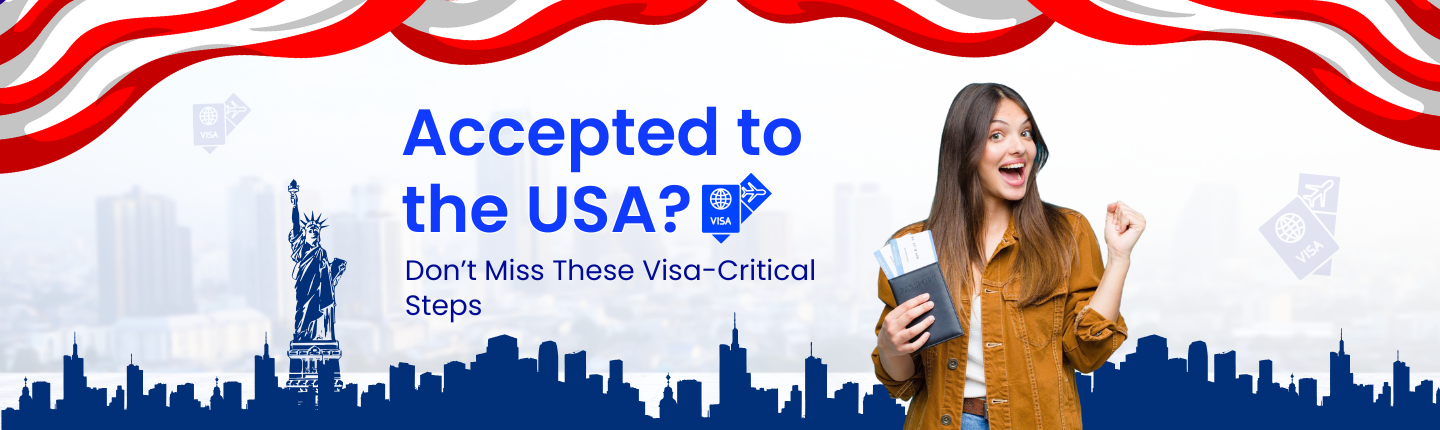
Life After Admission: Understanding Your I-20, SEVIS & Visa Process (Made Simple)
Share this blog


In this article
- Life After Admission: What Comes Next?
- The I-20 Explained: Your Most Important Immigration Document
- SEVIS: The System That Tracks Your Student Status
- Paying the SEVIS Fee: What, Why, and How
- Understanding the F-1 Student Visa Process
- Documents Required for US Student Visa
- Visa Interview: What Officers Really Look For
- Common Mistakes to Avoid After Admission
- Timeline Table: Admission to Visa Approval
- Freaquently Asked Questions
Life After Admission: What Comes Next?
Receiving an admission letter from a US university is a milestone moment. It validates months—sometimes years—of preparation, exams, applications, and waiting. But once the celebration settles, a new phase begins: immigration compliance. This stage determines whether your academic dream actually turns into a physical presence on a US campus.
Many students assume admission guarantees a visa. It does not. Admission is an academic decision; the visa is an immigration decision. Understanding how these two worlds intersect is the key to a smooth transition from acceptance email to boarding pass.
This guide simplifies the entire journey—your I-20, SEVIS record, and F-1 visa—without legal jargon or confusion. Think of it as your roadmap to studying legally and confidently in the United States.
“A student visa USA is not about where you are going—it’s about why you will return.” — Former US Visa Officer (Educational Outreach Program)
The I-20 Explained: Your Most Important Immigration Document
The Form I-20, officially called the Certificate of Eligibility for Nonimmigrant Student Status, is issued by a SEVP-certified US institution. Without this document, you cannot apply for an F-1 visa, pay the SEVIS fee, or enter the United States as a student.
The I-20 is not just paperwork—it represents a formal agreement between you, your university, and the US government.
What Information Does the I-20 Contain?
The document includes your personal details, program of study, degree level, start and end dates, estimated cost of attendance, and proof that you have sufficient funds to cover at least one academic year.
It also lists your Designated School Official (DSO)—the person legally responsible for updating your student status in the US immigration system.
Why Accuracy Matters
Even a minor error—like a misspelled name or incorrect date of birth—can lead to visa delays or rejection. Always review every line before signing the student attestation section.
SEVIS: The System That Tracks Your Student Status
SEVIS stands for Student and Exchange Visitor Information System. It is a real-time database maintained by the US Department of Homeland Security to monitor international students and exchange visitors.
Once your university issues the I-20, your SEVIS record is activated. From that moment onward, your academic and immigration status are digitally tracked.
SEVIS records:
- Your enrollment status (full-time or not)
- Program start and end dates
- Address updates in the US
- Authorized work (CPT/OPT)
- Transfers or program changes
Failing to comply with SEVIS requirements can lead to termination of your student status—even if your academic performance is strong.
Paying the SEVIS Fee: What, Why, and How
Before applying for fees to study in the USA, you must pay the I-901 SEVIS fee. This fee supports the maintenance of the SEVIS system and is mandatory for all first-time F-1 applicants.
Key Details
- Fee amount: USD $350 (subject to change)
- Payment portal: https://www.fmjfee.com
- Must be paid at least 3 days before visa interview
The payment receipt is a critical document required for US student visa interviews and port-of-entry checks.
Understanding the F-1 Student Visa Process
The F-1 visa allows you to enter the US as a full-time academic student. It does not grant permanent residency, nor does it guarantee employment after graduation.
How to Apply for Study Visa in the USA
The process involves completing the DS-160 form, paying the MRV fee, scheduling biometrics (if applicable), and attending a visa interview at a US embassy or consulate.
What officers assess is not just documentation, but intent. They want clarity on your academic goals, financial readiness, and plans after graduation.
If you are wondering why study in USA with an F1 visa answer matters so much—it’s because this single question tests your seriousness, research, and long-term planning.
Documents Required for US Student Visa
Having the correct documents required for US student visa is non-negotiable. Missing even one can impact the outcome.
You should carry:
- Original Form I-20 (signed)
- SEVIS fee payment receipt
- Valid passport (6+ months beyond program end)
- DS-160 confirmation page
- Visa appointment letter
- Academic transcripts and test scores
- Financial documents (bank statements, loan letters, affidavits)
- University admission letter
Financial clarity is often the deciding factor in visa approvals.
Visa Interview: What Officers Really Look For
Popular belief holds that the visa interviews are not interrogations. They are short structured tests that aim at testing credibility.
Officers focus on:
- Logical academic development. U
- niversity and program fit
- Financial sustainability
- Strong home-country ties
The issues are confidence, honesty, and consistency than memorized answers.
Common Mistakes to Avoid After Admission
Many students who study abroad in USA unintentionally sabotage their visa chances by rushing or relying on hearsay.
Avoid:
- Submitting inconsistent financial documents
- Memorized or generic answers
- Ignoring I-20 errors
- Applying too late in the intake cycle
Preparation beats panic—every time.
Timeline Table: Admission to Visa Approval
| Stage | Estimated Timeframe |
| Receive Admission Offer | Day 0 |
| Accept Offer & Submit Documents | 1–2 weeks |
| I-20 Issuance | 7–14 days |
| SEVIS Fee Payment | Same day |
| Visa Interview Scheduling | 2–6 weeks |
| Visa Decision | Same or within 7 days |
Need help on how to apply for a study visa in USA? Nomad Credit here to make the process easy for you! Get help from an expert!

Frequently Asked Questions
Is the I-20 the same as a US student visa?
No, the I-20 and the F-1 visa are completely different documents, though they are closely connected. The I-20 is issued by your US university and confirms that you are academically eligible and financially capable of studying in the United States. The F-1 visa, on the other hand, is issued by the US government and allows you to enter the country. You must first receive the I-20 before you can apply for a US student visa.
What happens if there is a mistake on my I-20?
Any error on your I-20—such as an incorrect name, date of birth, course duration, or funding amount—can create serious issues during your visa interview or at US immigration checkpoints. If you notice a mistake, you should immediately contact your university’s Designated School Official (DSO) and request a corrected I-20 before proceeding with the visa application.
Can I use an education loan as proof of funds for my F-1 visa?
Yes, education loans are widely accepted as valid financial proof, provided they are sanctioned by a recognized bank or financial institution. The loan approval letter should clearly mention the sanctioned amount, borrower name, and purpose of study. Many students combine education loans with personal or sponsor funds to fully cover the cost mentioned on the I-20.
How important is the SEVIS fee for the visa process?
The SEVIS fee is mandatory and non-negotiable. You would not be allowed to continue with your F-1 visa interview without the SEVIS I-901 fee. The fee will connect your SEVIS ID to the US immigration system and will also ensure that your student record has become active. Visa officers regularly inspect SEVIS payment records prior to granting visas.
When should I apply for my US student visa after receiving the I-20?
You are supposed to apply to get your visa immediately you get your I-20 and do your SEVIS payment. Although the latest date of entry into the US is 30 days prior to your program start date, the visa interviews fill up soon, usually around peak intake periods. Early application allows you to have flexibility in case of administrative processing or delays.

Share this blog
Get Expert Admission Guidance
It’s completely free.
Related Blogs


Admissions
M7 MBA Acceptance Rates, GMAT Scores & Class Profiles
Key Takeaways Getting into M7 MBA schools like Harvard or Stanford is incredibly competitive, only a small percentage of applicants…
4 min
Admissions
Complete Guide to Summer Intake in Canada 2026: Date and Details
Key Takeaways: The summer intake in Canada (May 2026) isn’t the main intake, but it still gives you…
5 min
Get Expert Admission Guidance
Helping students worldwide choose top universities and secure their dream admits.

Popular Blogs Section




Financing dreams of global
nomads



Student Support
support@nomadcredit.comPartner Support
partnerships@nomadcredit.com
Important Links
Offices

Chicago, US
Millennium Centre, 33 W Ontario St Suite 18D, Chicago, IL 60654,
United States

Mumbai, India
Sundervilla, A wing 314B, Hasmukh Nagar, Santacruz (West), Mumbai,
MH 400054
Registered Office
We
work, Goregaon, Building 4, North Wing, NESCO IT Park, Western
Express Highway, Goregaon East, Mumbai, MH 400063
GST Regn
No:
27AAGCN6529G1Z9
Partner
offices in 30+
cities globally
 Copyright
© Unifi Lending LLC. All Rights Reserved.
Copyright
© Unifi Lending LLC. All Rights Reserved.