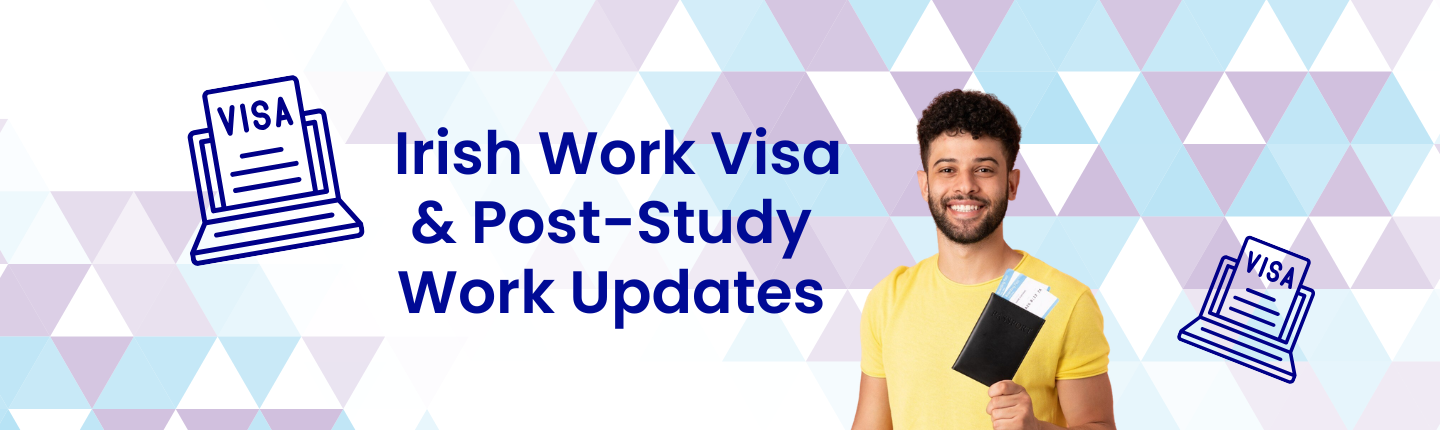
Irish Work Visa & Post-Study Work Updates: How to Build Long-Term Careers
Share this blog


In this article
- Post-Study Work Rights in Ireland: What’s Actually Changed
- Irish Work Visa Types You Need to Know
- Top Universities in Ireland for International Students
- Cost of Education in Ireland: The Real Picture
- Ireland Student Visa: Step-by-Step Breakdown
- How Indian Students Are Building Careers in Ireland
- Benefits of Studying Abroad (That No One Talks About)
- Frequently Asked Questions
If you’ve been researching where to study master’s abroad, Ireland keeps coming up — and for very good reason. It sits at a fascinating crossroads: English-speaking, deeply integrated into the EU economy, and home to the European headquarters of companies like Google, Meta, Apple, LinkedIn, and Pfizer.
For Indian students, especially, this is a serious advantage. The country’s tech and pharma sectors are actively hiring, and Ireland’s immigration framework has evolved to support international graduates who want to stick around after their degree.
What makes it stand out isn’t just the job market. It’s the combination of a welcoming student culture, globally ranked universities, a manageable cost of education in Ireland, and a post-study work pathway that’s arguably cleaner and more straightforward than the UK or Canada right now.
Ireland Post-Study Work Visa (TLGP) – Quick Overview
- Duration: 24 months (Master’s graduates)
- Eligibility: Degree from a recognised Irish institution
- Work Rights: Full-time job search allowed
- Transition: Move to Critical Skills or General Employment Permit
- Key Advantage: No job offer required to apply
Post-Study Work Rights in Ireland: What’s Actually Changed
This is where things get genuinely exciting. Ireland overhauled its Third Level Graduate Program (TLGP) — the main post-study stay-back option — and the updates have been well-received by the international student community.
Here’s what the current framework looks like:
- Master’s degree holders are eligible for a 24-month stay-back permit under the TLGP, allowing them to remain in Ireland and seek employment after graduation.
- Bachelor’s degree holders get 12 months, while PhD graduates get 24 months.
- The graduate stay permit is tied to your Irish institution and degree — not to a job offer at the time of application.
- Once employed, graduates can transition to a General Employment Permit (GEP) or a Critical Skills Employment Permit (CSEP), depending on salary and role.
The Critical Skills Employment Permit is particularly valuable. If your annual salary is above €38,000 and your occupation is on Ireland’s Critical Skills Occupations List (which includes IT, engineering, healthcare, and finance roles), you can apply directly — bypassing the traditional labour market needs test.
For Indian students targeting tech, data science, or pharma careers, this is a significant pathway to long-term EU residency.
Irish Work Visa Types You Need to Know
Navigating Irish immigration feels complex at first, but the system is quite structured once you understand the two main employment permit types.
Critical Skills Employment Permit (CSEP)
- For roles earning €38,000+/year on the critical skills list
- Grants immediate access to the labour market for spouses and dependents
- Eligible for long-term residency (Stamp 4) after 21 months
General Employment Permit (GEP)
- For roles not on the critical skills list, earning a minimum of €34,000/year
- Requires a Labour Market Needs Test (employer must advertise the role for 4 weeks)
- Stamp 4 eligibility after 5 years
A few things worth knowing before applying:
- Both permits are employer-sponsored — your Irish employer files the application on your behalf (or jointly with you).
- Applications go through DETE (Department of Enterprise, Trade and Employment).
- Processing times typically run 4–6 weeks for online applications.
- Renewals are possible, and the pathway to Irish citizenship (via naturalization) opens after 5 years of legal residence.
The Ireland student visa during your studies operates under Stamp 2, which allows up to 20 hours of part-time work per week during term and full-time during holidays — another reason students can build local work experience before they even graduate.
Top Universities in Ireland for International Students
The institution is important for academic quality and employability after your studies. The university scene in Ireland is smaller in scale to the UK but impressive in terms of rankings and sector specialization.
| University | QS World Ranking 2026-27 | Known For | Location |
| Trinity College Dublin (TCD) | 81 | Law, Business, Computer Science | Dublin |
| University College Dublin (UCD) | 181 | Engineering, Business, Agriculture | Dublin |
| University College Cork (UCC) | 303 | Medicine, Food Science, Law | Cork |
| University of Galway | 351–400 | Marine Science, Medicine, Arts | Galway |
| Dublin City University (DCU) | 601–650 | Communications, Engineering, Business | Dublin |
| Maynooth University | 801–1000 | Computer Science, Social Sciences | Kildare |
Among the top universities in Ireland, Trinity College Dublin consistently leads in global rankings. UCD and UCC are close behind, particularly for STEM and business programmes. For Indian students aiming at tech careers, DCU’s School of Computing and TCD’s School of Computer Science and Statistics have excellent industry ties.
Cost of Education in Ireland: The Real Picture
Let’s be honest — Ireland is not the cheapest destination. But it’s also not the most expensive, and when you factor in earning potential post-graduation, the numbers make sense.
Tuition Fees (Annual Estimates)
- Undergraduate programmes: €10,000 – €25,000/year
- Postgraduate (taught Master’s): €10,000 – €35,000/year
- MBA programmes: €20,000 – €45,000/year
- Research-based Master’s/PhD: Often funded or subsidised
Living Costs (Monthly Estimates)
- Dublin: €1,200 – €1,800/month (accommodation is the biggest variable)
- Cork / Galway: €900 – €1,400/month
- Food, transport, and personal expenses: €400 – €600/month
Scholarships worth knowing about:
- Government of Ireland International Education Scholarships (100% fee waiver + €10,000 stipend)
- Science Foundation Ireland (SFI) Scholarships for STEM students
- University-specific scholarships at TCD, UCD, and UCC — available through direct applications
The cost of education in Ireland is offset meaningfully when you factor in the 20-hour work allowance during studies — students working part-time in Dublin can earn €12–€15/hour at minimum, contributing €500–€1,200/month toward living costs.
Ireland Student Visa: Step-by-Step Breakdown
The ireland student visa process is managed through the Irish Naturalisation and Immigration Service (INIS) and is generally considered more transparent than many other countries.
Here’s the standard process for non-EEA students (including Indian nationals):
Step 1 — Receive a Conditional Offer Letter Before applying for a visa, you need a confirmed offer from an Irish institution recognised by Qualifications and Quality Ireland (QQI).
Step 2 — Pay Tuition Fees (or First Year Instalment) INIS typically expects proof that fees have been paid or partially paid — this demonstrates genuine intent.
Step 3 — Gather Required Documents
- Valid passport (for at least 12 months beyond duration of study)
- Offer or acceptance letter from Irish institution
- Financial evidence (€7,000–€10,000 in accessible funds)
- Results of English language proficiency test (IELTS 6.0+ for most courses)
- Medical insurance
- Completed application form (VFS Global for Indian citizens)
Step 4 — Apply via VFS Global (India) Indian students apply through VFS Global centres. Biometrics are collected during this step.
Step 5 — Visa Processing Standard processing: 6–8 weeks from application submission. Some peak periods (June–August) can take longer — apply early.
Step 6 — Register with GNIB/IRP on Arrival Within 90 days of arriving in Ireland, all non-EEA students must register with the Garda National Immigration Bureau (GNIB) and obtain their Irish Residence Permit (IRP card) — this is your legal right to stay and study.
How Indian Students Are Building Careers in Ireland?
This is where the real story lives. The Indian student community in Ireland has grown substantially over the past five years. According to Irish universities’ enrollment data and the Higher Education Authority (HEA), India consistently ranks among the top three non-EU nationalities studying in Ireland — alongside China and the US.
The pathway Indian students are following most successfully looks something like this:
- Study a taught Master’s in Computer Science, Data Analytics, Fintech, or Supply Chain Management
- Use the 24-month TLGP stay-back to job hunt and build local connections
- Get employed in one of Dublin’s tech hubs (Silicon Docks) and apply for a CSEP
- Apply for Stamp 4 after 21 months — which removes employment permit requirements entirely
- Apply for Irish citizenship after 5 years of legal residence
What’s particularly relevant for Indian students is that Ireland doesn’t require you to score on a points-based system (unlike Canada or Australia). Your qualifications and a job offer do most of the heavy lifting.
Benefits of Studying Abroad in Ireland (That No One Talks About)
Most people list the obvious benefits of studying abroad — better degrees, global exposure, higher salaries. But the ones that actually shape careers tend to be subtler.
- You learn how to navigate ambiguity. Moving countries, managing bureaucracy, adapting to new norms — these aren’t just life skills. They’re exactly what employers in international firms look for.
- Your network becomes genuinely global. Classmates in Ireland often come from Germany, Brazil, Nigeria, and the US. That diversity in your immediate circle has compounding professional value.
- You build a credibility signal that’s hard to replicate. A Master’s from TCD or UCD — completed in English, in a competitive international cohort — carries weight in India and globally.
- You encounter career paths you didn’t know existed. Roles in EU policy, fintech regulation, climate tech, or pharmaceutical supply chain are barely on the radar in India but are booming in Ireland.
- It changes your baseline for confidence. Students always comment on how the challenge of living independently abroad catalyzes personal and professional maturation in a way that education in your home country often does not.
For anyone considering whether Ireland is truly the best country for a master’s abroad for Indian students, the stay back, access to the EU job market, Indian diaspora, and English language education make it a truly strong case.

Frequently Asked Questions
Can Indian students work in Ireland after completing their Master’s degree?
Yes — and this is one of Ireland’s most attractive features for international graduates. Under the
Third Level Graduate Programme (TLGP), students who complete a Master’s degree at a recognised Irish institution are eligible for a 24-month stay-back permit. This allows them to remain in Ireland and search for employment without needing a job offer upfront.
What is the minimum IELTS score required for the Ireland student visa?
The majority of Irish universities demand a minimum score of 6.0–6.5 in the IELTS test, with no band being less than 5.5–6.0. However, the requirement may differ according to the course and university, especially in the case of MBA and law programs. TOEFL (with a score of 79–90) and PTE Academic, C1 Advanced of Cambridge are also accepted.
Is Ireland a good option for Indian students compared to the UK or Canada in 2026?
Ireland has become increasingly competitive with both the UK and Canada as a study masters abroad destination. The UK’s Graduate Route visa is currently under review and may face restrictions, while Canada has tightened its study permit caps.
How much money do I need to show for the Ireland student visa as an Indian applicant?
The Irish immigration authorities typically expect applicants to demonstrate access to €7,000–€10,000 in personal or family funds, in addition to proof of tuition fee payment.
What are the career sectors with highest demand for international graduates in Ireland?
Ireland’s economy is heavily concentrated in a few high-growth sectors, and these align well with what Indian students typically study. The technology sector — covering software engineering, data science, cybersecurity, and cloud computing — is the single largest employer of international graduates, anchored by Dublin’s Silicon Docks. Pharmaceutical and life sciences (led by companies like Pfizer, MSD, and Johnson & Johnson) are the second major sector.

Share this blog
Speak to an Expert
It’s completely free.
Related Blogs
Admissions
Online vs Traditional Study Abroad Counselling: Which One Actually Works Better for Today’s Students?
Key Takeaways: Online study abroad counselling offers convenience without compromising expert guidance. Traditional counselling remains valuable for students…
6 min
Admissions
Why Students Who Start with Free Study Abroad Counselling Make Better Admission Decisions
Key Takeaways: Free study abroad counselling helps students shortlist universities based on eligibility, not just rankings. A detailed…
5 min
Speak to an Expert
Trusted by students in 9+ countries to secure funds for their dreams

Popular Blogs Section



Financing dreams of global
nomads




Student Support
support@nomadcredit.com
Partner Support
partnerships@nomadcredit.com
Important Links
Offices

Chicago, US
Millennium Centre, 33 W Ontario St Suite 18D, Chicago, IL 60654,
United States

Mumbai, India
Sundervilla, A wing 314B, Hasmukh Nagar, Santacruz (West), Mumbai,
MH 400054
Registered Office
We
work, Goregaon, Building 4, North Wing, NESCO IT Park, Western
Express Highway, Goregaon East, Mumbai, MH 400063
GST Regn
No:
27AAGCN6529G1Z9
Partner
offices in 30+
cities globally
 Copyright
© Unifi Lending LLC. All Rights Reserved.
Copyright
© Unifi Lending LLC. All Rights Reserved.
Speak to an expert
