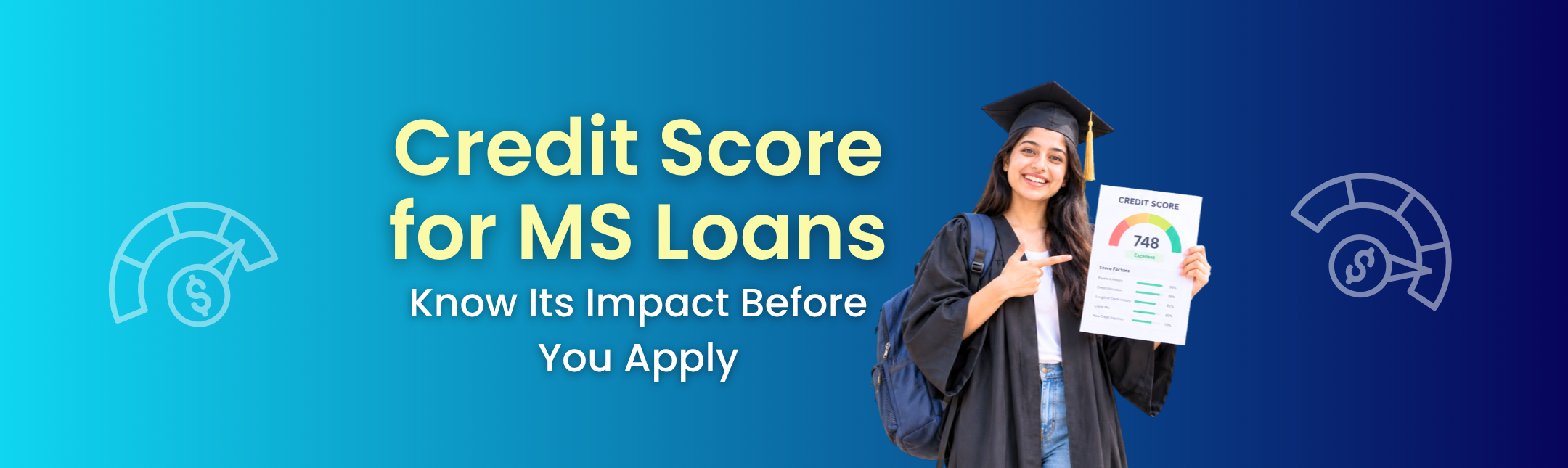
Credit Score Required for an MS Education Loan in the USA
Share this blog


In this article
- Why Does Your Credit Score Matter for an MS Education Loan?
- Whose Credit Score Does the Lender Check?
- What CIBIL Score Is Required for an Education Loan for MS in the USA?
- How Do Indian Banks and NBFCs Assess Your Credit?
- What Credit Score Does a US Cosigner Need?
- Can You Get an MS Loan Without a Cosigner?
- Can You Get an Education Loan With a Low CIBIL Score?
- How Does Your Credit Score Affect Loan Approval and Interest Rates?
- How Can You Improve Your Credit Profile Before Applying?
- How Nomad Credit Can Help With Your MS Education Loan
- Conclusion: Your Credit Score Is Important, But It Isn’t Everything
- Frequently Asked Questions
Planning an MS in the USA comes with plenty of exciting decisions, which university to choose, which specialization to pursue, and where you want your career to go. But once you start figuring out how to fund your degree, another question usually comes up: What credit score do I need for an education loan?
There isn’t one credit score that guarantees an education loan for an MS in the USA. The requirement depends on the lender, type of loan, whether you have a co-applicant or cosigner, and several other eligibility factors.
For Indian education loans, lenders may consider your CIBIL score and/or your co-applicant’s credit profile. If you’re applying for a US loan with a US cosigner, the lender evaluates the cosigner according to its US credit requirements, not their Indian CIBIL score. And some international lenders offer eligible students loans without requiring a cosigner or an established credit history.
So, instead of focusing on one magic number, it helps to understand whose credit score matters for your loan and how lenders use it.
For Indian education loans, a CIBIL score of 750 or above is generally considered strong, but it is not a universal cutoff. Some lenders may consider applications with lower scores depending on the co-applicant’s financial profile, repayment capacity, collateral, university, course and other eligibility factors.
Why Does Your Credit Score Matter for an MS Education Loan?
A credit score gives lenders an indication of how a borrower has managed credit in the past. It can reflect factors such as repayment history, outstanding debt and length of credit history.
When evaluating an education loan application, lenders may use credit information to understand the risk involved in lending money.
However, your credit score isn’t necessarily the only factor determining whether your loan gets approved.
Depending on the lender and loan type, the assessment may also consider:
- Your university and course
- Loan amount required
- Co-applicant’s income and repayment capacity
- Existing financial obligations
- Collateral, where applicable
- Academic profile
- Required loan documentation
- Expected career prospects
This is why two students with similar credit scores can receive different loan offers.
Whose Credit Score Does the Lender Check?
This is where education loans can get confusing.
The person whose credit profile matters depends largely on the type of loan you’re applying for. Your own CIBIL score isn’t automatically the deciding factor in every MS loan application.
| Loan Type | Whose Credit May Be Checked? | What Else May Matter? |
| Indian bank/NBFC loan | Student and/or co-applicant | Income, course, university, collateral |
| US cosigner loan | US cosigner | US credit history and lender criteria |
| No-cosigner international loan | Requirements vary by lender | University, program, profile and future earning potential |
Understanding this difference can save you from rejecting a potentially suitable loan simply because you don’t have a long credit history yourself.
What CIBIL Score Is Required for an Education Loan for MS in the USA?
Indian banks and NBFCs set their own credit and underwriting criteria, so there is no single minimum CIBIL score that applies to every education loan.
A stronger CIBIL score can generally make your application more attractive because it indicates responsible credit behaviour. A lower score, on the other hand, may make approval more difficult or limit the loan options available to you.
A score of 750 or above is generally considered a strong CIBIL score, but that does not mean every education loan requires a minimum score of 750.
Similarly, having a score below that level doesn’t automatically mean your application will be rejected.
Students with a weaker credit profile may still have options, as eligibility for a low CIBIL education loan can depend on the co-applicant’s finances, repayment capacity, collateral, and the lender’s individual criteria.
How Do Indian Banks and NBFCs Assess Your Credit?
If you’re applying through an Indian bank or NBFC, the lender may assess both the student’s and co-applicant’s profiles.
Many students applying directly after university may have little or no credit history. This is different from having a low score caused by missed payments or other repayment issues, and lenders may rely more heavily on the co-applicant’s financial profile in such cases.
The lender may evaluate factors such as:
- CIBIL score and credit history
- Monthly or annual income
- Existing EMIs and loans
- Repayment history
- Employment or business stability
- Relationship between student and co-applicant
- Loan amount requested
- Collateral offered, if applicable
Banks and NBFCs don’t necessarily evaluate these factors in exactly the same way, so eligibility can differ between lenders.
If you’re still comparing funding options, understanding the overall process for an education loan for MS in the USA can help you narrow down lenders based on your financial situation.
What CIBIL Score Should a Co-Applicant Have?
Your co-applicant’s CIBIL score for an education loan can be important when the lender relies on the co-applicant’s income and financial history to assess repayment capacity.
A strong credit profile can support the application, while a lower score may lead the lender to examine the overall case more carefully.
Apart from the score itself, lenders can consider:
- Previous loan repayments
- Credit card payment history
- Existing debt
- Current income
- Employment stability
- Debt obligations compared with income
This is an important distinction: credit score and repayment capacity aren’t the same thing.
Someone can have a good credit score but already carry significant financial obligations. That’s why lenders usually assess the broader financial picture.
What Credit Score Does a US Cosigner Need?
A US cosigner loan works differently from an Indian education loan.
If your education loan requires a US cosigner, that person will generally need to be a qualifying US citizen or permanent resident and meet the lender’s eligibility requirements.
Most importantly, a US cosigner isn’t evaluated using an Indian CIBIL score.
US lenders assess the cosigner using US credit information and their own underwriting standards.
There is also no universal US cosigner credit score that every lender accepts. One lender may have different eligibility requirements from another, and credit score is only one part of the assessment.
The lender may consider the cosigner’s:
- US credit history
- Repayment record
- Income
- Existing debt
- Employment
- Overall creditworthiness
A stronger US credit profile may improve eligibility or the terms offered, but it doesn’t guarantee approval or a particular interest rate.
Students who have an eligible person willing to support their application can explore a US cosigner loan for study in the USA and compare lender-specific requirements before applying.
Can You Get an MS Loan Without a Cosigner?
Yes, some international students may qualify for an MS loan without a cosigner, depending on the lender, university, program and individual profile.
Certain international lenders have loan products specifically designed for students who don’t have access to a US cosigner.
Instead of relying entirely on a cosigner’s credit history, these lenders may consider factors such as:
- University
- Degree program
- Academic background
- Graduation timeline
- Expected career prospects
- Future earning potential
- Other lender-specific eligibility criteria
However, no-cosigner doesn’t mean no eligibility requirements. The lender will still assess whether you fit its lending criteria.
This can be useful for international students who don’t have access to an eligible US cosigner.
Can You Get an Education Loan With a Low CIBIL Score?
A low CIBIL score can make some education loan applications more challenging, but it doesn’t automatically close every financing option.
Your options will depend on the lender’s criteria and the strength of the rest of your application, including your co-applicant’s finances, existing obligations and any collateral offered.
You may be able to strengthen your application by:
- Applying with a financially stronger eligible co-applicant
- Exploring lenders with different eligibility criteria
- Considering a secured education loan if suitable
- Reducing existing outstanding debt before applying
- Clearing overdue payments
- Correcting errors in your credit report
- Comparing Indian and international education loan options
If collateral is one of the factors affecting your decision, you can also explore how a USA education loan without collateral works before choosing a lender.
Don’t submit applications to several lenders blindly. Compare your eligibility first and focus on options suited to your financial profile.
How Does Your Credit Score Affect Loan Approval and Interest Rates?
Credit can influence several aspects of an education loan, but its exact impact differs by lender.
Loan Eligibility
A stronger credit history is that it can signal responsible payment habits on your part and hence boost your chances of getting the loan approved. Bad credit may put you under more scrutiny or reduce your options for loans.
Interest Rate
Creditworthiness can be one factor lenders use when deciding what interest rate to offer. However, you shouldn’t expect a particular interest-rate reduction simply because your score crosses a certain number.
The final education loan interest rate can depend on the lender, loan structure, applicant profile and other underwriting factors.
Loan Amount
Your credit profile may contribute to the lender’s decision about the amount it is prepared to offer. Income, collateral, university, course and repayment capacity may also influence the final sanctioned amount.
Loan Terms
Depending on the lender, your overall financial profile can influence the loan terms available to you. A good credit score may help, but it doesn’t guarantee specific repayment conditions.
How Can You Improve Your Credit Profile Before Applying?
If you’re planning your MS several months in advance, use that time to get your finances in order.
Consistent financial habits are much more useful.
- Pay your dues on time: Late EMI and credit card payments can negatively affect your credit history. Set reminders or automatic payments where appropriate.
- Review your credit report: Check your credit report before applying. If you find inaccurate information, follow the relevant process to have it corrected.
- Reduce outstanding debt: If possible, lower existing balances and financial obligations before taking on a large education loan.
- Avoid unnecessary credit applications: Applying for several forms of credit within a short period may result in multiple credit enquiries.
- Keep older accounts in mind: The age and history of your credit accounts can contribute to your overall credit profile.
- Plan with your co-applicant: If you have a college loan that is dependent mostly on your parent or any other co-borrower, then it is wise to assess his/her financial standing earlier rather than later before the university deadline.
Most importantly, don’t take out unnecessary debt simply to try to improve your credit score.
How Nomad Credit Can Help With Your MS Education Loan
The right education loan depends on more than the advertised loan amount or interest rate.
The right option can depend on your university, course, required loan amount, co-applicant profile, collateral availability and whether you have access to a US cosigner.
Nomad Credit helps international students explore education loan options based on their individual profiles. Instead of trying to work out every lender requirement yourself, you can compare suitable options and understand which route may work for your MS plans.
Conclusion: Your Credit Score Is Important, But It Isn’t Everything
Your CIBIL score for an education loan for MS in the USA can influence your financing options, but there isn’t one minimum score that works for every lender.
If you’re borrowing through an Indian lender, your and/or your co-applicant’s CIBIL profile may be assessed. If you’re using a US cosigner, the lender evaluates that person’s US credit profile rather than an Indian CIBIL score. And if you don’t have a cosigner or personal credit history, certain lenders may offer alternatives based on different eligibility criteria.
Check out your credit report and that of your co-applicant/cosigner before comparing loans according to your full financial and academic status, and not just one credit score number.

Frequently Asked Questions
What CIBIL score is required for an education loan for MS in the USA?
There is no fixed CIBIL score required by every lender. A score of 750 or above is generally considered strong, but lenders also consider factors such as the co-applicant’s finances, loan amount, university, course and collateral, where applicable.
Is a 750 CIBIL score compulsory for an education loan?
No. A score of 750 or above is generally considered strong, but it isn’t a universal requirement. Each lender has its own credit criteria.
Does the co-applicant’s CIBIL score matter?
Yes. For many Indian education loans, the co-applicant’s financial profile can be an important part of the lender’s assessment. Lenders may consider their CIBIL score, income, existing debts and repayment history.
What credit score does a US cosigner require?
Each lender has its own minimum score requirement. The requirements vary among the lenders and also depend on the analysis of the US credit history of the co-signer and overall financial standing.
Can I get an education loan with a low CIBIL score?
A low CIBIL score will not necessarily disqualify you from applying for an educational loan. You may try to apply at other lenders with varied eligibility criteria or apply with a qualified co-applicant or opt for a secured loan.
Can I get an MS loan without a cosigner?
Yes, some international lenders offer no-cosigner loans to eligible students. They may consider your university, course, academic profile, and future earning potential.
Can I get a student loan with no credit history?
Yes, depending on the lender and loan type. Having no credit history doesn’t automatically make you ineligible. The lender may instead consider your co-applicant or cosigner, academic profile, university, course and other eligibility factors.

Speak to an Expert
It’s completely free.
Related Blogs

Bank, Finances & Tips
When is the Best Time to Refinance Student Loans: Key Factors to Know
If you’re asking when to refinance student loans, here’s the direct answer: the best time to refinance student…
7 min
Education Loan
How to Get an Education Loan for MS in Canada?
An MS education loan in Canada requires more than planning for the tuition charges. Accommodation costs, expenses of…
13 mins
Speak to an Expert
Trusted by students in 9+ countries to secure funds for their dreams

Popular Blogs Section



Financing dreams of global
nomads




Student Support
support@nomadcredit.com
Partner Support
partnerships@nomadcredit.com
Important Links
Offices

Chicago, US
Millennium Centre, 33 W Ontario St Suite 18D, Chicago, IL 60654,
United States

Mumbai, India
Sundervilla, A wing 314B, Hasmukh Nagar, Santacruz (West), Mumbai,
MH 400054
Registered Office
We
work, Goregaon, Building 4, North Wing, NESCO IT Park, Western
Express Highway, Goregaon East, Mumbai, MH 400063
GST Regn
No:
27AAGCN6529G1Z9
Partner
offices in 30+
cities globally
 Copyright
© Unifi Lending LLC. All Rights Reserved.
Copyright
© Unifi Lending LLC. All Rights Reserved.
Speak to an expert
