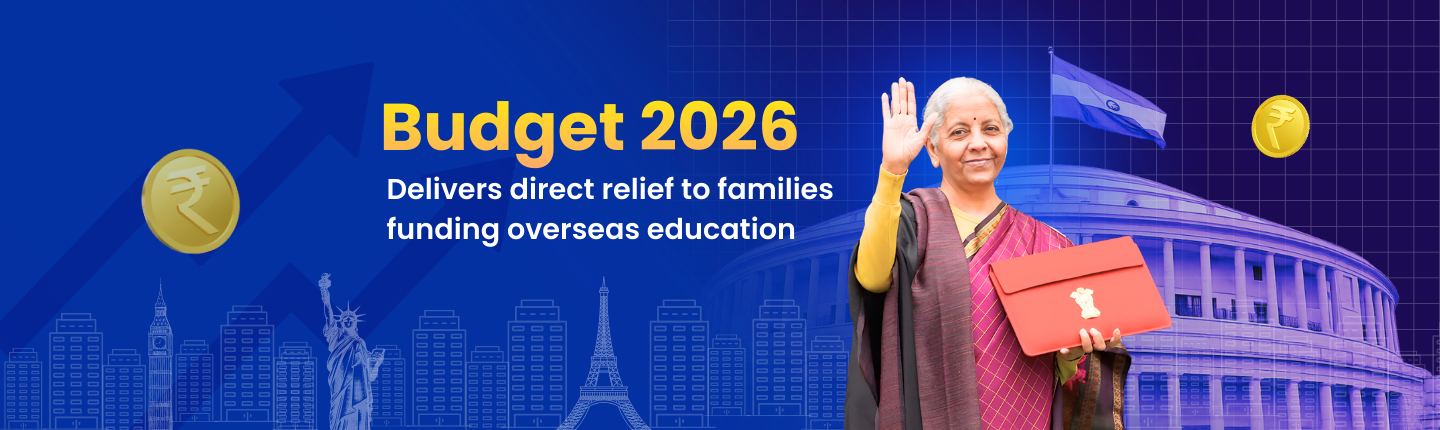
Union Budget 2026: A Positive Reset for Indian Students Planning to Study Abroad
Share this blog


Strategic Breakdown: How Budget 2026 Rewrites the Rulebook
Although the story behind the Union Budget 2026 is one of relief, the actual impact lies in the operational efficiency it provides to the average Indian citizen. Beyond the crude figures, this policy change addresses the opportunity cost of capital. When a family is forced to park several lakhs with the tax department, they forgo potential interest and the ability to hedge against currency fluctuations.
The transition from a 5% to a 2% TCS regime is a structural nod to the growing importance of the “global Indian student.” It acknowledges that an overseas education loan is not a luxury spend, but a critical investment in human capital. The government is addressing the immediate liquidity crisis by ensuring students do not face cash shortages mid-semester, allowing them to focus on GRE/GMAT exam preparation and university orientations.
Its Time to Started Your Journey
The “Why & How” of the TCS Reduction
In order to negotiate this new landscape, students and parents need to be aware of the particular touchpoints where such savings are made. The following is a rocky overview of the advantages.
- Upfront Liquidity: Families now retain 3% more of their total remittance amount immediately. This is crucial during the high-expense “departure window” (July–September).
- Reduced Loan Burden: If you include the TCS amount in your student loans for international students, a lower tax rate means a lower principal balance, leading to lower interest accrual over time.
- Streamlined Tax Filing: The 5% rate frequently led to large refunds that could be contested, whereas the 2% rate is more in line with average tax amounts, making the final ITR filing less problematic.
- Extended Access: International lenders that offer study abroad loans without a co-signer may accept personal savings as the initial deposit. The 2% cap makes these “out-of-pocket” payments much more manageable.
- Currency Hedging: With more cash on hand, families can remit funds when the exchange rate is favorable, rather than being forced to remit exactly the amount needed plus a 5% tax.
A Practical Example: The “Real World” Savings
Let’s look at a concrete example of a student, Rohan, who is heading to the US for an MS in Data Science. His total first-year study-abroad eligibility (Tuition + Living Expenses) is ₹50 Lakh.
Step 1: The Threshold- The first ₹10 Lakh is exempt from TCS. The tax applies only to the remaining ₹40 Lakh.
Step 2: The Old vs. New Comparison
Under the 5% Rule (Pre-2026):
- TCS = 5% of ₹40 Lakh = ₹2,00,000
- Total cash needed to send ₹50 Lakh = ₹52,00,000
Under the 2% Rule (Budget 2026):
- TCS = 2% of ₹40 Lakh = ₹80,000
- Total cash needed to send ₹50 Lakh = ₹50,80,000
The Impact: Rohan’s father now has ₹1,20,000 extra in his savings account. Instead of waiting 12 months for a tax refund, this money can now be used to buy Rohan’s laptop, his premium health insurance, and his flight tickets—all without taking an additional top-up loan.
Navigating the Transition: Tips for Students
- Label Your Remittance: Make sure your bank codes the transfer as being under the code of education purpose so that the 2 percent rate is induced rather than the higher rates which would be applicable on general travel.
- Consult the Experts: Discuss with study abroad consultants who understand the interplay between forex and tax. They can schedule your payments to take full advantage of the 3% savings.
- Loan Documentation: If your overseas education loan is disbursed in stages, ensure you collect your TCS certificate after each installment to facilitate tax filing later.
- Threshold Tracking: Remember that the ₹10 Lakh limit is cumulative for the financial year across all banks. Don’t assume each bank gives you a fresh ₹10 Lakh limit!
Budget 2026 Checklist For Abroad
The Role of Experts in a Changing Economy
Navigating these changes isn’t something most families can do alone. This is where study abroad consultants play a pivotal role. An expert consultant does more than just help with the SOP or the visa application; they are now financial strategists. They help families decide when to remit funds to capitalize on currency dips and ensure the 2% TCS documentation is correctly filed, so there are no surprises at the bank counter.
In conclusion, studying abroad is a complicated financial move; it is no longer an academic choice. As the government reduces the tax barrier and the market offers a more flexible loan product, 2026 is the best year to pursue a global degree. The message from the Budget is clear: India wants its students to go out, gain global skills, and bring that expertise back, without being weighed down by unnecessary tax “traps” along the way.
Frequently Asked Questions
Is the 2% TCS an additional cost that I will never get back?
No, the Tax Collected at Source (TCS) is not a final tax. It is essentially an advance tax payment that is linked to your PAN card. When your parents or the remitter files their Income Tax Returns (ITR) at the end of the financial year, the 2% collected will be adjusted against their total tax liability.
Does the 2% rate apply to money sent for living expenses or just tuition?
The 2% TCS rate under the Liberalised Remittance Scheme applies to all remittances made for the purpose of education, provided you have the necessary documentation (like a university offer letter or an I-20).
How does this impact students who have taken an overseas education loan from an Indian bank?
If you have a loan from a registered Indian financial institution under Section 80E, you are in a very good position.
What documentation do I need to prove that my remittance is for education?
To avail of the 2% rate, your bank will require proof of purpose. This usually includes a copy of your passport, the admission letter from the foreign university, and a fee estimate.
Can I remit more than ₹10 lakh without paying any TCS?
No, the TCS kicks in once the cumulative remittance in a financial year exceeds the ₹10 lakh threshold. However, keep in mind that the tax is only calculated on the “extra” amount.

Related Blogs


When is the Best Time to Refinance Student Loans: Key Factors to Know
If you’re asking when to refinance student loans, here’s the direct answer: the best time to refinance student…
7 min
No-Cosigner vs US-Cosigner Student Loans for the USA
No-cosigner & US-cosigner loan options help you study abroad. This blog compares their interest rates & other features…
7 min
Speak to an Expert
Trusted by students in 9+ countries to secure funds for their dreams

Popular Blogs Section









Student Support
support@nomadcredit.com
Partner Support
partnerships@nomadcredit.com

 Copyright
© Unifi Lending LLC. All Rights Reserved.
Copyright
© Unifi Lending LLC. All Rights Reserved.