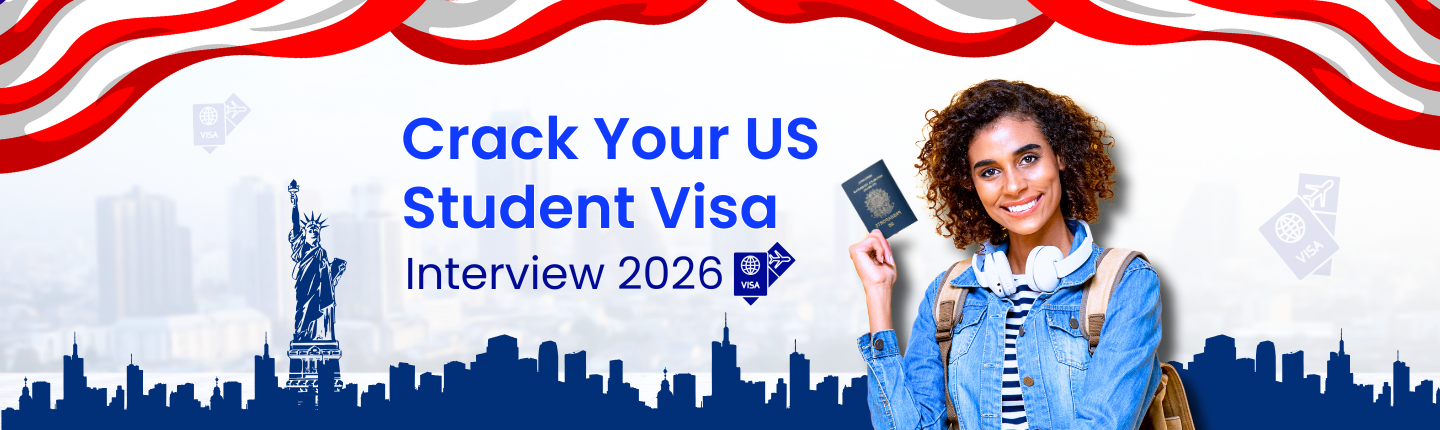
US Student Visa Interview 2026: Common Questions & Winning Answers
Share this blog


In this article
A successful U.S. student visa interview is the closing of your entire study abroad application journey. It is a brief, yet extremely important, dialogue with a consular officer, during which your genuine intention to pursue an education and your plans for returning to your country of origin after completing your education are assessed.
The interview is not an empty formality, but a test of your preparedness, honesty, and confidence. To make the best of this important step, to be prepared to express your academic ambitions clearly, prove strong ties with your home country, and give an interesting and well-structured narrative that will prove you are a sincere and qualified student.
By planning for frequently asked questions and developing concise responses, you can make a strong case presentation and secure final approval for the study in the USA as an international student.
Why the 2026 US Interview Holds Weight?
The U.S. student visa interview is your final step toward studying in America. As of mid‑2025, new regulations require in‑person interviews for most applicants, including students, so there’s zero room for improvisation. Preparing for 2026 means gearing up for well‑structured, live questioning by a consular officer keen to assess your academic goals, financial clarity, and ties back home.
What Officers Really Want to Know:
Consular officers test three main things:
- Are you a genuine student?
- Can you afford your stay?
- Will you return after your studies?
Each question you face is designed to probe these core concerns of why to study in the United States.
Document Readiness & Process Overview: US Student Visa Interview
Ensure you’re fully organized. Key documents include: I‑20 form, DS‑160 confirmation, SEVIS fee receipt, transcripts, test scores, bank statements.
Process steps at a glance:
| Step | Action |
| 1 | Receive I‑20 from SEVP‑approved school |
| 2 | Pay SEVIS (I‑901) fee |
| 3 | Complete DS‑160 |
| 4 | Book and attend biometrics (VAC) |
| 5 | Attend in‑person interview |
Top Common Interview Questions & Smart Answers to crack the US visa for an International Student
The key to a successful interview isn’t memorizing scripted answers, but rather understanding the purpose behind each question. By preparing for common inquiries about your academic goals, financial support, and plans, you can present yourself as a confident, well-prepared, and credible candidate.
Here’s how to handle the most frequent prompts:
1. “Why do you want to study in the USA?”
Answer approach: Be precise. Cite academic strength, research infrastructure, or global exposure for
process to study in the USA.
“I chose the U.S. because the state-of-the-art labs of [University Name] in my area of study, along with a hands-on learning atmosphere, are consistent with my professional goals in renewable energy.”
This reflects a genuine academic motive, not a migration intent.
2. “Why this university or course?”
Answer approach: Tailor your response, cite curriculum uniqueness, specific professors, or institutional reputation.
“The Business Analytics program at [Univ] offers a rare blend of data science with experiential learning—exactly what I need.”
3. “How will you fund your education for study abroad?”
Answer approach: Detail your funding model, personal savings, educational loans, or scholarships. Avoid speculating about future earnings in the U.S.
4. “Do you plan to return home after studying?”
Answer approach: Clearly convey future ties, mention career prospects, family, or roles waiting back home.
“Post‑graduation, I plan to work in my family’s engineering firm in Jaipur, as my newly acquired skills would directly benefit our projects there.”
5. “How many universities did you apply to, and why this semester?”
Answer approach: Be honest. If you applied broadly or chose a specific intake due to merit or scheduling, explain succinctly.
Things to be mindful of in a US Student Visa Interview
In 2026–27, consular officers are particularly vigilant about red flags like fraudulent documents, vague answers, or uncertain funding. Steer clear of:
- Overstated family income
- Unsure or general answers
- Hinting you want to stay in the U.S. permanently
- Speak clearly, confidently, and honestly.
Kickstart Your U.S. Study Journey Now
Effective Interview Strategy for US Visa and Study Abroad
A visa interview is a crucial step in your journey of studying abroad in the U.S. Planning ahead, with emphasis on clear and confident communication, and a sound understanding of your academic and financial planning, is fundamental to success. Here’s a quick checklist to help you shine:
- Dress formally, be neat, and be confident.
- Work out your introduction (Introduce yourself… etc.) so it’s smooth.
- Know your funding and educational goals cold
- Keep answers short—even for self‑introduction—then elaborate when asked
- End with a polite “Thank you,” and a calm demeanor
So, credibility emerges from the combination of accurate academic motivation, explicit financial preparedness and positive intentions of home country. Remember: it’s about demonstrating that you’re educated, financially stable, and well-grounded.
Final Thought
Think of the 2026 U.S. student visa interview as a short, high‑stakes conversation where clarity wins. Showcase your academic plan, proof of funds, and real intent to return—prepare thoughtfully, and walk in calm. You’ll present not as a visa-seeking visitor, but as a committed, well-prepared scholar.
Good luck—We believe you’ve got this, but if you still have doubts, study abroad consultants are always there to help!

Frequently Asked Questions
What changed in 2025 that affects 2026 interviews?
Starting September 2, 2025, in‑person interviews became mandatory for almost all visa applicants—including students—removing previous exemptions.
What essential documents should I carry?
You need: I‑20, SEVIS fee receipt, DS‑160 confirmation, financial affidavits, transcripts, test scores, and a passport.
What kinds of questions are most commonly asked?
Expect questions probing your educational intent, chosen course/university, financial status, and post‑study plans.
How can I convince the officer I’ll return home after studies?
Highlight specific post‑graduation opportunities at home—family business, job offers, market gaps. Be concrete in your ties.
Should I talk about employment options like OPT or CPT?
Don’t give the impression that you’re there just to work. Focus on study objectives. Discuss OPT/CPT only in response to a direct question and share it as part of academic training.

Share this blog
Speak to an Expert
It’s completely free.
Related Blogs

Admissions
Online vs Traditional Study Abroad Counselling: Which One Actually Works Better for Today’s Students?
Key Takeaways: Online study abroad counselling offers convenience without compromising expert guidance. Traditional counselling remains valuable for students…
6 min
Admissions
Why Students Who Start with Free Study Abroad Counselling Make Better Admission Decisions
Key Takeaways: Free study abroad counselling helps students shortlist universities based on eligibility, not just rankings. A detailed…
5 min
Speak to an Expert
Trusted by students in 9+ countries to secure funds for their dreams

Popular Blogs Section


Financing dreams of global
nomads




Student Support
support@nomadcredit.com
Partner Support
partnerships@nomadcredit.com
Important Links
Offices

Chicago, US
Millennium Centre, 33 W Ontario St Suite 18D, Chicago, IL 60654,
United States

Mumbai, India
Sundervilla, A wing 314B, Hasmukh Nagar, Santacruz (West), Mumbai,
MH 400054
Registered Office
We
work, Goregaon, Building 4, North Wing, NESCO IT Park, Western
Express Highway, Goregaon East, Mumbai, MH 400063
GST Regn
No:
27AAGCN6529G1Z9
Partner
offices in 30+
cities globally
 Copyright
© Unifi Lending LLC. All Rights Reserved.
Copyright
© Unifi Lending LLC. All Rights Reserved.
Speak to an expert
