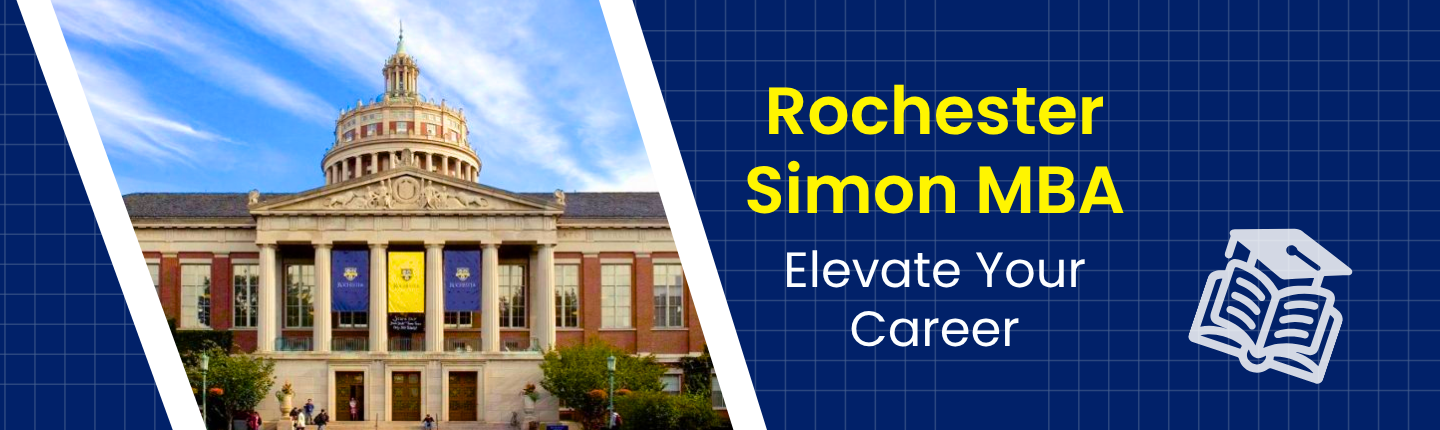
University of Rochester Simon MBA: Admissions, Fees & Career Outcomes.
Share this blog


Simon Business School at the University of Rochester runs a two-year, full-time MBA in Rochester, New York, with a STEM-designated option, a test-optional admissions policy, and a small, tight-knit class of around 90 students. For the Class of 2025, 88% of job-seeking graduates accepted employment within three months of graduation, with average total compensation of $162,175. This guide walks through current admissions requirements, fees, scholarships, and career outcomes for the Simon Full-Time MBA, sourced directly from Simon’s official pages.
Begin Global MBA Counseling Today
Simon Business School MBA: Quick Overview
- University: University of Rochester
- Business School: Simon Business School
- Location: Rochester, New York
- Program: Full-Time MBA
- Duration: 2 years
- Entry: July
- STEM Option: Available
- GMAT/GRE/EA: Optional
- English Tests: TOEFL, IELTS, or Duolingo; waivers may apply
- Application Fee: $90*
- Average Work Experience: 5.2 years (Class of 2027)
- Scholarships: 90% of MBA students receive scholarship support
- Career Outcome: 88% of job-seeking Class of 2025 graduates accepted employment within 3 months
Source: Official Website
Why Consider the Simon MBA?
Simon is ranked #34 in the US by U.S. News & World Report and #29 by the Financial Times (2026), which also placed it #2 in the US for salary growth in 2026. Bloomberg Businessweek ranked Simon #6 for ROI among the top 35 US business schools in 2025.
Beyond rankings, three things distinguish the program: a genuinely small, close-knit cohort (roughly 90 students per class), a curriculum built around Simon’s long-standing strength in economics and analytics, and a STEM-designated MBA option available across every concentration, something few US business schools offer at this scale. For students weighing USA universities for an MBA, Simon is worth shortlisting if you want an analytically rigorous program with a strong quant reputation and a manageable cost of attendance relative to peer schools.
Simon MBA Curriculum and Concentrations
The Full Time MBA involves 68 credit hours, which consist of a mandatory core curriculum of nine subjects, a two course Communication for Business Decision Making requirement, Structured Problem Solving, and the Project course. The students can then select electives from ten different concentrations within three tracks, or else follow the general management track:
- Finance Track: Asset Management, Banking, Corporate Finance, Venture Capital & Private Equity
- Marketing Track: Brand Management, Product Management
- Consulting Track: Operations, Pricing, Strategy, Technology
A concentration isn’t mandatory; students who prefer breadth can build a general management course plan instead. Simon also offers combined degrees, including an MD/MBA with the University of Rochester’s School of Medicine and Dentistry and an MA/MBA with the Eastman School of Music.
Is the Simon MBA STEM-Designated?
Yes. Simon was the first US business school to offer a STEM-designated option across every Full-Time MBA concentration. To graduate with the STEM designation, at least 50% of a student’s total credits must come from STEM-designated courses.
This is important for international students since graduates who get a job that qualifies as STEM will have their Optional Practical Training extended for 24 months, giving them three years of authorized work in the US without an H-1B visa. However, it is important to note that it does not affect employment nor visa sponsorship directly.
Simon MBA Admission Requirements
Simon’s Admissions Committee reviews applications holistically; no single number (test score, GPA, or years of experience) functions as a hard cutoff.
Academic Requirements
Simon evaluates your undergraduate and any graduate transcripts, with particular attention to business, accounting, and math coursework alongside your cumulative GPA. The current Class of 2027 enrolled with an average GPA of 3.3. This figure describes the incoming class profile; it is not a stated minimum, and applicants with a lower GPA are encouraged to address it briefly in the optional essay.
Work Experience
Simon values not only internships but also any work experience after completing one’s baccalaureate education, balancing quality and quantity. On average, members of the Class of 2027 had 5.2 years of professional experience (range 80th percentile: 1.6–8.7 years), being 29 years old on average.
GMAT, GRE & Executive Assessment
This is where many older guides go out of date: Simon Business School currently allows Full-Time MBA applicants to apply without submitting a GMAT exam, GRE exam, or Executive Assessment score. There is no minimum score requirement. If you do choose to submit one, Simon suggests comparing your score against the class profile’s middle 80% range as a guide, the current class averaged 675 on the GMAT (10th edition), 625 on GMAT Focus, and 316 on the GRE. Submitting a strong score can still help candidates from quant-light academic or professional backgrounds, and for certain functions (investment banking, consulting), some employers prefer to see one.
English Language Requirements
International applicants whose native language isn’t English need to demonstrate proficiency for both admission and visa issuance. Simon currently recommends a minimum TOEFL exam score of 100 (with sub-scores in the mid-20s), a minimum IELTS exam score of 7.0, or a Duolingo English Test score of 125. These are recommended benchmarks rather than hard minimums, and Simon reviews TOEFL exam and IELTS exam waiver eligibility on a case-by-case basis; it’s worth checking directly with Admissions if you believe you qualify.
Essays and Application Documents
The current Full-Time MBA application checklist includes:
- A business-style resume (not CV), preferably one to two pages maximum
- An essay (400-700 words)
- Video essay – an opportunity for the Admissions Committee to get past your application documents
- Official transcript from all colleges/universities attended
- Details for the recommenders to send their letters of recommendation via the online application
- GMAT, GRE, or Executive Assessment test scores (optional)
- TOEFL, IELTS, or Duolingo test scores (for international students)
- Application fee of $90
Since admission requirements may vary from year to year, it is crucial to always double-check the latest essay prompt, word count, and list of documents needed in Simon’s official admissions section before writing your essays.
Simon MBA Fees and Cost of Attendance
For the 2026–2027 academic year, Simon Business School’s Full-Time MBA tuition is $60,000 per year. Estimated annual living and program expenses are:
|
Item |
Estimated Cost |
|
Tuition |
$60,000/year |
|
Activity Fee |
$800/year |
|
Mandatory Health Fee |
$1,107/year |
|
Health Insurance |
$4,216/year |
|
Housing (rent/utilities) |
$11,340/year |
|
Food |
$6,970/year |
|
Travel |
$2,500/year |
|
Personal Expenses |
$2,716/year |
|
Books |
$1,310/year |
|
International Services Office Fee |
$140/year |
|
International Student Programming Fee |
$900 one-time |
Simon MBA Scholarships and Financial Aid
Simon awards nearly $5 million in scholarships and fellowships each year, and 90% of Full-Time MBA students receive merit-based scholarship support. Awards range from $50,000 up to full tuition, with some full-tuition scholarships including an additional $10,000-per-year stipend. Scholarship consideration is automatic with your application, there’s no separate scholarship form, and the amount, if awarded, is included with your admission offer.
University of Rochester or Simon alumni are eligible for a 50% tuition scholarship toward the Full-Time MBA.
Simon MBA Application Process and Deadlines
Simon reviews Full-Time MBA applications on a rolling basis across four rounds:
|
Round |
Application Window |
Deadline |
Decision By |
|
Round 1 |
September 1 – October 15 |
October 15 |
December 15 |
|
Round 2 |
October 16 – January 5 |
January 5 |
March 15 |
|
Round 3 |
January 6 – March 1 |
March 1 |
April 15 |
|
Round 4 |
March 2 – May 1 |
May 1 |
June 1 |
Simon MBA Career Outcomes
Employment Rate
Of the Class of 2025’s job-seeking graduates, 88% had accepted employment within three months of graduation.
Salary / Compensation
Class of 2025 graduates earned an average total compensation of $162,175. Simon was ranked #2 in the US for salary growth by the Financial Times in 2026.
Top Industries and Employers
- Technology: 25.9% of graduates
- Financial Services: 17.6%
- Healthcare: 15.3%
- Marketing/Sales roles: 27.1%
- Finance/Accounting roles: 23.5%
- Consulting roles: 18.8%
- Career Support: One-on-one guidance through Simon’s Benet Career Management Center, from resume preparation to employer connections.
Is the Simon Business School MBA Right for You?
Simon tends to suit candidates who want a quant-heavy, economics-grounded MBA inside a small cohort rather than a large-network program. It’s a strong fit if:
- You want the option to apply without submitting a GMAT exam or GRE exam score and let your work history and essays carry more weight
- A STEM-designated MBA and the OPT extension it enables matter to your post-MBA plans as an international student
- You’re drawn to Simon’s finance, consulting, or marketing concentrations and want deep specialization rather than broad electives
- You value close faculty access and a tight peer group over a very large alumni base
It may be less of a fit if you’re specifically targeting a mega-network MBA with hundreds of classmates per city, or if your target function (say, brand marketing at a major consumer company) is more concentrated at schools with larger placement volumes in that space. Reviewing the class profile and career outcomes report against your own goals is the best way to judge fit, especially if you’re comparing Simon to other USA universities on your shortlist.
How to Finance Your Simon MBA
Domestic students may be eligible for federal and private loan options through the University of Rochester’s Financial Aid Office. International students, who typically can’t access US federal loans, generally rely on a private education loan for USA study, including lenders that offer loans without a US-based cosigner. Simon has an established relationship with College Ave for a no-cosigner loan covering tuition (less scholarship) plus fees, and also points students toward ELMSelect to compare private lender options for an education loan for USA admission.
If you’re researching an education loan for MBA in USA programs generally, it’s worth comparing interest rates, repayment terms, and cosigner requirements across a few lenders before committing since these vary significantly between providers and can meaningfully change your total repayment cost. Start the process early most lenders offering an education loan for MBA in USA need a conditional or unconditional admission letter before they’ll issue a sanction, so shortlisting lenders while your Simon application is under review can save time later.

Frequently Asked Questions
Is Simon Business School MBA STEM-designated?
Yes. Simon Business School was the first U.S. business school to offer a STEM-designated Full-Time MBA option across all concentrations. International students on an F-1 visa can qualify for up to a 3-year OPT STEM extension upon graduation.
Does Simon MBA require GMAT or GRE?
No. Simon Business School offers a test-optional policy, meaning submitting a GMAT, GRE, or Executive Assessment (EA) score is not mandatory. Applicants can choose whether or not to include a standardized test score as part of their application.
What are the admission requirements for Simon MBA?
The primary application requirements include:
- An online application form and fee
- A current resume and work history
- Required essays
- Transcripts from all post-secondary institutions
- English language proficiency test scores (if applicable)
- GMAT/GRE/EA scores (optional)
- Admission interview (by invitation)
What English test scores does Simon MBA accept?
Simon accepts the following exams for international applicants:
- TOEFL (Recommended minimum: 100)
- IELTS (Recommended minimum: 7.0–7.5)
- Duolingo English Test (DET) (Recommended minimum: 125)
Waivers are available if your prior degree was completed entirely in English.
How much does the Simon MBA cost?
Tuition is approximately $57,500 per year. When factoring in health insurance, books, and living expenses, the total estimated cost of attendance is around $88,000 to $88,500 per year.
Does Simon Business School offer scholarships to international students?
Yes. All applicants, including international students, are automatically considered for merit-based scholarships and fellowships during the holistic application review process. No separate scholarship application is required.

Share this blog
Speak to an Expert
It’s completely free.
Related Blogs

Courses
Courses in Canada for International Students
Canada offers international students a wide range of courses across technology, business, engineering, healthcare, finance and other career-focused…
10 min
Courses
Top STEM Courses in Canada for International Students
Explore STEM courses in Canada in this blog. Dive in-depth for eligibility, application, benefits, documents, & job opportunities…
9 min
Speak to an Expert
Trusted by students in 9+ countries to secure funds for their dreams

Popular Blogs Section




Financing dreams of global
nomads




Student Support
support@nomadcredit.com
Partner Support
partnerships@nomadcredit.com
Important Links
Offices

Chicago, US
Millennium Centre, 33 W Ontario St Suite 18D, Chicago, IL 60654,
United States

Mumbai, India
Sundervilla, A wing 314B, Hasmukh Nagar, Santacruz (West), Mumbai,
MH 400054
Registered Office
We
work, Goregaon, Building 4, North Wing, NESCO IT Park, Western
Express Highway, Goregaon East, Mumbai, MH 400063
GST Regn
No:
27AAGCN6529G1Z9
Partner
offices in 30+
cities globally
 Copyright
© Unifi Lending LLC. All Rights Reserved.
Copyright
© Unifi Lending LLC. All Rights Reserved.
Speak to an expert
