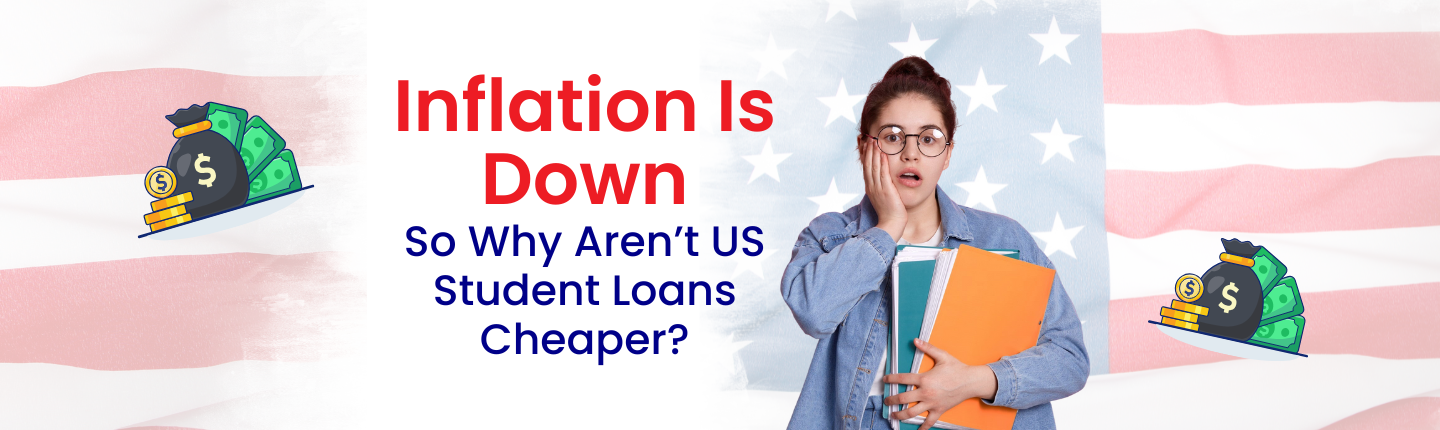
US Student Loan Rates Explained: Why Rates Stay High Even When Inflation Falls
Share this blog


Planning your study abroad journey and wondering why US student loan rate feels stubbornly high even as inflation cools? You’re not alone.
Many international students and parents are puzzled, especially when headlines say inflation is down. But student loans march to their own beat.
Let’s break down what really drives student loan rates, like Fed decisions, SOFR changes, and lender risk costs, in a way that’s easy for students to understand.
Start Your Application With Clarity
Why US Student Loan Rates Don’t Fall With Inflation?
Even as inflation cools, many students expect US student loan rates to drop too, but that rarely happens. These rates are influenced by deeper financial systems, not just everyday price trends.
Here’s why they stay high even when inflation falls.
The Fed Isn’t Setting Your Loan Rate
Most people think lowering inflation equals lower loan rates. But federal student loans are tied to market benchmarks, not the Consumer Price Index (CPI). The Federal Reserve did not always reduce rates when inflation decreased. Rather, it realigns short-run policy rates gradually and cautiously to equalize the growth.
SOFR – The New Benchmark
The SOFR (Secured Overnight Financing rate) is being applied in federal student loans, replacing the old rates (such as LIBOR). In contrast to inflation, SOFR represents the current lending rates between banks in the market. Markets are still pricing in past rate hikes and uncertainty, so SOFR remains relatively elevated.
This matters more to international students considering interest rate for abroad education loan options, especially private ones linked to SOFR or similar benchmarks.
Risk Premium Keeps Overall Rates High
Lenders include a risk premium, extra cost to protect against defaults. There is great uncertainty in student loans: students might not graduate, enter low-paying jobs or leave the US. This premium does not disappear with a declining inflation.
Long‑Term vs. Short‑Term
US student loan interest rates are backward-looking and pegged on long-term prospects (10-year Treasury yields), rather than current consumer prices. Even with lower inflation, long‑term yields haven’t dropped enough to sharply cut loan rates.
What Really Decides My Student Loan Interest Rate?
“If inflation is down, why are loan rates still so high?”
It’s a common question, but student loan rates don’t simply follow inflation. Instead, they depend on a mix of economic indicators, policies, and market behavior. Here’s a clear breakdown of the major forces behind your loan rate.
| Factor | What It Means | Impact on Your Rate |
| Fed Policy Rates | Central bank lending costs influence markets | Indirect; slow effects |
| SOFR (Benchmark) | Bank overnight lending rate | Direct; keeps base higher |
| Risk Premium | Compensation for possible default | Adds on top of base rate |
| Loan Term Expectations | Long‑term yield forecasts | Keeps rates elevated |
How Do These Rates Impact Me as an International Student?
“Okay, but how does this affect my actual loan offer?”
Great question. It is important to know how these finances influence the actual costs you pay whether you are comparing lenders or even when you are budgeting. Let’s connect the dots from policy to personal impact.
| Student Need | Typical Concern | What Actually Drives It |
| Federal loan cost | Why isn’t inflation lowering rates? | SOFR + yield expectations |
| Private loan cost | Why can I see variable rates? | Benchmarks + credit risk |
| International students | Can I get lower rates for abroad education loan? | Depends on co‑signer & credit profile |
What This Means for Your Study Abroad Budget
Even if inflation drops, you may still face higher student loan interest rate for study abroad, especially from private lenders.
Federal loans tend to cost less, but many international students need co-signers or other options. Understanding SOFR and risk can help you make smarter loan decisions.
So, Will My Loan Rates Ever Go Down?
It’s tempting to hold off, hoping for a better deal, but student loan rates are shaped by complex, slow-moving forces that don’t always respond quickly to falling inflation.
Instead of waiting, take action with the right guidance. At Nomad Credit, our expert study abroad consultants help you compare loan options, understand what affects your rates, and find the most affordable financing tailored to your profile.
Don’t let high rates delay your dreams, connect with a Nomad Credit study abroad consultant today and move one step closer to your global education.

Frequently Asked Questions
Why do private lenders often have higher interest rates?
The risk premium charged by the private lenders is higher, particularly to the international students who have no credit history in the US or co-signers. This increases higher rates than the federal loan rates.
Does a lower inflation rate guarantee cheaper education loans later?
Not always. Loan rates are based more on market trends and future expectations than today’s inflation. Waiting might not get you a better rate, and it could set your plans back.
How can I reduce the total interest paid on my student loan?
You can reduce interest by borrowing only what you need, paying interest during your study period, or choosing lenders with flexible repayment and lower margins.
What role does a co-signer play for international student loans?
Interest rate can be reduced by a co-signer who has good credit in the US. This minimizes the risk of the lender and this will assist you in getting better rates.
Is it better to choose a fixed or variable interest rate?
Fixed rates are predictable and this is safer in a volatile market. Variable rates can be low but can increase, which is a possibility given that the repayment is over a period of years.

Share this blog
Get Expert Admission Guidance
It’s completely free.
Related Blogs

Education Loan
Education Loan for Master’s Abroad: Complete Guide for Indian Students
A master’s degree abroad can open doors to global career opportunities, but financing it requires careful planning. Between…
14 min
Education Loan
SBI Global Ed-Vantage Education Loan for USA
Key Takeaways: The SBI Global Ed-Vantage education loan scheme provides loans for pursuing higher education in renowned universities…
8 min
Get Expert Admission Guidance
Helping students worldwide choose top universities and secure their dream admits.

Popular Blogs Section



Financing dreams of global
nomads




Student Support
support@nomadcredit.com
Partner Support
partnerships@nomadcredit.com
Important Links
Offices

Chicago, US
Millennium Centre, 33 W Ontario St Suite 18D, Chicago, IL 60654,
United States

Mumbai, India
Sundervilla, A wing 314B, Hasmukh Nagar, Santacruz (West), Mumbai,
MH 400054
Registered Office
We
work, Goregaon, Building 4, North Wing, NESCO IT Park, Western
Express Highway, Goregaon East, Mumbai, MH 400063
GST Regn
No:
27AAGCN6529G1Z9
Partner
offices in 30+
cities globally
 Copyright
© Unifi Lending LLC. All Rights Reserved.
Copyright
© Unifi Lending LLC. All Rights Reserved.
Speak to an expert
